


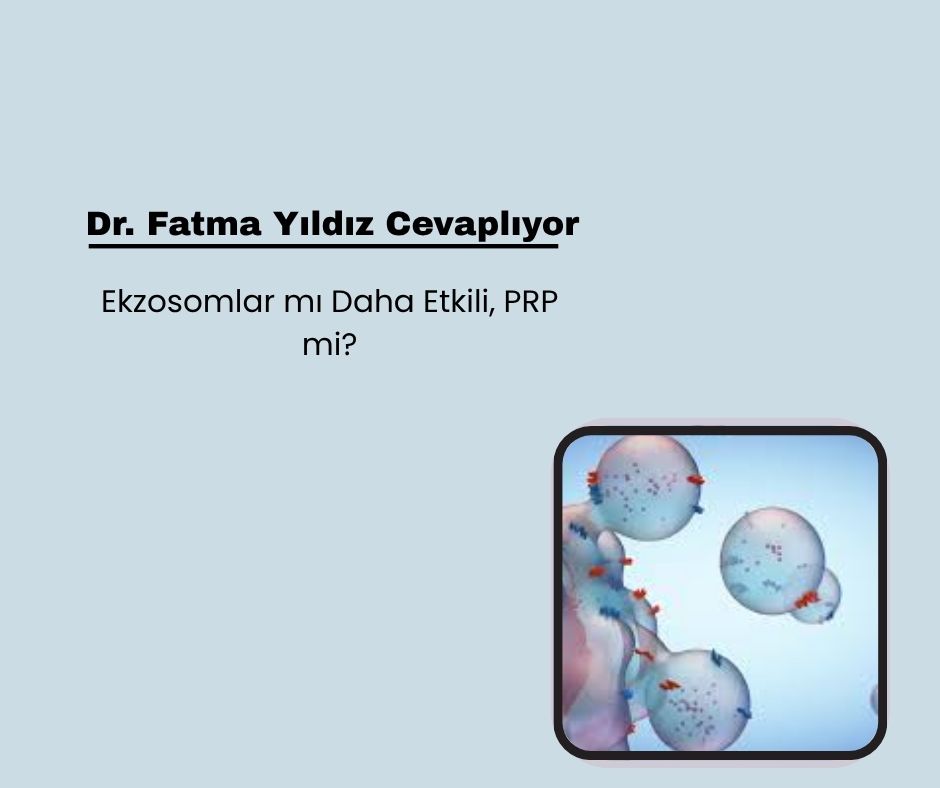

Are Exosomes More Effective or PRP?
Two innovative treatments have been gaining traction in the field of skin rejuvenation in recent years: exosomes and platelet-rich plasma (PRP). These two regenerative medicine options aim to support the skin's natural healing mechanisms, increase collagen production, restructure skin tissue, and reduce the signs of aging. So, is PRP or exosomes more effective for skin rejuvenation?
What Are Exosomes and How Do They Benefit the Skin?
Exosomes are defined as a special subclass of extracellular vesicles. These nanosized particles carry biologically active substances such as messenger RNAs, proteins, lipids, and microRNAs. By facilitating communication between cells, they particularly support mechanisms such as collagen production, angiogenesis (blood vessel formation), and inflammation regulation.
Studies show that exosomes offer significant benefits in:
Rejuvenating photo-aged skin
Improving acne scars
Reducing hair loss
Inflammatory skin conditions such as atopic dermatitis
It has also been reported to further enhance dermal remodeling when combined with microneedling or laser treatments.
What is PRP and How is it Used for Skin Rejuvenation?
PRP (Platelet Rich Plasma) is a plasma product derived from a person's own blood and containing a high concentration of platelets. Thanks to its growth factors such as PDGF, VEGF, and TGF-β, it:
Increases fibroblast activity
Supports new blood vessel formation in the skin
Contributes to the remodeling of the extracellular matrix.
When used in conjunction with microneedling and laser treatments, PRP promotes more intense collagen production in the skin tissue and reduces the appearance of wrinkles.
So, Which is More Effective: Exosomes or PRP?
The first clinical study to answer this question was conducted using a split-face design. This meant that PRP was applied to one half of each participant's face and exosome treatment to the other. This minimized the impact of individual differences. The treatments were administered in conjunction with three sessions of radiofrequency microneedling (RFMN). This method not only stimulated collagen production by creating controlled skin damage but also allowed the PRP and exosomes to penetrate the skin better.
How Was the Application Performed?
The exosomes were obtained from fat stem cells using a specialized system. They contained various active ingredients that support skin healing.
The PRP was prepared by centrifuging the participant's blood using a specialized system and then activated and used.
After the treatment, separate protocols were applied to each side. A special healing cream was applied to the exosome-treated side, while only petroleum jelly was applied to the PRP-treated side.
What Did the Clinical and Histological Results Show?
Throughout the study, criteria such as skin appearance, wrinkle depth, blemishes (dyschromia), erythema, and textural quality were assessed blindly by the researchers. Additionally, skin biopsies taken from some participants were used to examine type I and III collagen production and glycosaminoglycan (GAG) levels.
The results showed that:
Both PRP and exosomes resulted in significant improvements in skin quality.
Faster healing and higher collagen density were observed in the exosomes-applied area.
Both treatments were well tolerated, with no significant side effects.
What Were the Advantages of Exosomes?
Standardized composition (does not vary from cell to cell).
Longer-lasting effectiveness.
Shorter recovery time after application.
Combination products (such as EXO BALM) also support the skin barrier.
Conclusion: Is Exosomes the Future in Skin Rejuvenation?
This pioneering study demonstrated the effectiveness and safety of both PRP and exosomes. However, the advantages offered by exosomes, such as their high biological activity, standardized composition, and shorter recovery time, position them as the skin rejuvenation method of the future.
To determine the most appropriate treatment for your skin, it is recommended to consult a dermatologist who specializes in this field. Regenerative medicine practices not only provide rejuvenation but can also improve the overall health and function of the skin.
 Call
Call
 Whatsapp