


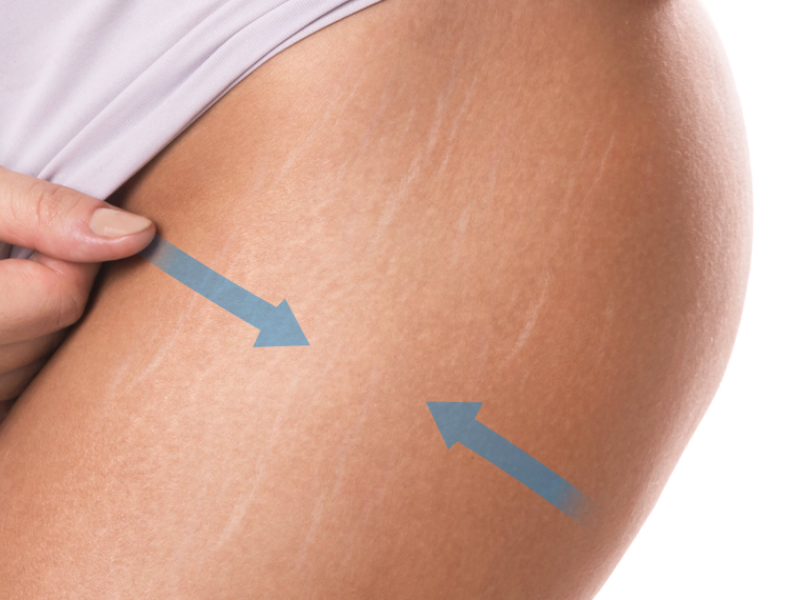

Gold Needle Stretch Mark Treatment combines microneedling with radiofrequency energy and may be used to reduce the visible appearance of selected stretch marks. Microneedles create controlled channels in the skin while RF energy is delivered at selected depths, producing a remodeling response.
Some individuals consider this approach for stretch marks associated with pregnancy, rapid growth, or changes in body size. Results vary and complete removal cannot be guaranteed.
The procedure is minimally invasive, but it is not suitable for every skin type or every stretch mark. Recovery and possible side effects depend on treatment depth and individual response.
Can Gold Needle and Laser Treatments Be Used Together?
Laser procedures and Gold Needle Stretch Mark Treatment can sometimes be included in the same overall treatment plan. However, they do not necessarily need to be performed during the same session.
Different laser systems target different components of the skin. Some fractional lasers primarily interact with water-containing tissue, while other systems target pigment or vascular structures. The reason for combining laser with RF should therefore be based on the specific treatment goal.
Using two procedures does not automatically create a stronger synergy or better result. Treatment sequencing and interval should be selected according to the devices, treatment depth, skin phototype, and recovery.
Gold Needle / RF Technology and Potential Advantages
Gold Needle / RF can create controlled thermal stimulation at selected dermal depths.
- Remodeling Effect: RF microneedling may support collagen remodeling and reduce selected textural irregularities.
- Recovery: Some protocols have relatively limited downtime, while more intensive settings can cause longer redness, swelling, or sensitivity.
- Individualization: Needle depth and RF settings can be adapted to the treatment area, but individualized treatment does not guarantee permanent results.
The procedure may also be considered for selected acne scars or texture concerns, but indications differ from stretch mark treatment.
Effects of Gold Needle Stretch Mark Treatment
Visible improvement may develop gradually over weeks or months.
The procedure may reduce the contrast or texture of selected stretch marks, but it does not necessarily restore normal skin architecture.
Results can persist for a period, but lifestyle or skin care cannot guarantee permanence. Future growth, pregnancy, weight changes, and hormonal factors may lead to new stretch marks.
What Should Be Expected During Treatment?
Treatment begins with assessment of the stretch marks, skin phototype, medical history, and treatment goals.
- Consultation and Assessment: The clinician evaluates whether RF, laser, another technique, or a combination may be appropriate.
- Treatment: Procedure time varies according to area size, device, and settings rather than always taking 30–60 minutes.
- Recovery: Redness, swelling, warmth, or sensitivity may occur and can last longer than several hours in some individuals.
Following suitable aftercare can support recovery but cannot optimize or guarantee the final result.
Differences Between Gold Needle Treatment and Laser Procedures
Gold Needle and laser technologies work through different mechanisms.
- Method: Gold Needle uses microneedles to deliver RF energy. Laser procedures use light energy and vary significantly according to wavelength and design.
- Targets: RF microneedling mainly creates controlled thermal remodeling at selected depths. Different lasers may target water, pigment, blood vessels, or other skin components.
- Recovery: Either treatment can involve mild or more substantial downtime depending on settings. Gold Needle is not universally more comfortable than every laser.
The most appropriate option depends on the stretch marks and skin characteristics.
When May Gold Needle and Laser Be Combined?
Combination treatment may be considered when different characteristics of the stretch marks or surrounding skin require different targets.
- Multiple Treatment Goals: One procedure may focus more on dermal remodeling while another targets selected color or surface characteristics.
- Staged Treatment: Rather than trying to obtain faster results, the methods may be separated by an appropriate recovery interval to avoid excessive inflammation.
- Individualized Planning: Treatment sequence, intensity, and interval should be selected according to the skin and devices used.
Performing both methods does not guarantee faster or more complete improvement. When treatments are applied too closely together or too aggressively, irritation, burns, prolonged redness, pigment changes, or other complications may become more likely.
A qualified professional should therefore determine whether combination therapy is appropriate and whether the treatments should be performed separately or as part of a staged plan.
 Call
Call
 Whatsapp