


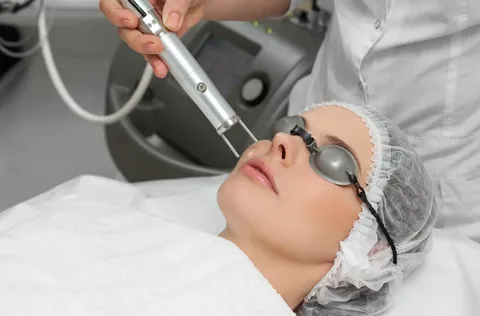

Co2 laser spot treatment provides targeted effects by exfoliating the skin. If the skin gets too hot, the blemish may be triggered. For this reason, it is recommended to be used carefully by individuals with very light skin in case of old age and sunspots. In general, carbon dioxide fractional laser causes damage to the skin surface and mid-skin. In this way, the body triggers its natural skin renewal mechanism. The healing that begins on the skin can go down to the deep layers of the skin. During this renewal, blemishes, acne scars and incision scars are also treated for very serious skin problems. Co2 laser treatment is not recommended for people with dark skin. Application in summer may also be risky after treatment.
Advantages of Co2 Laser Spot Treatment
The feeling of pain in Co2 laser spot treatment is quite low. The short time it takes to return to daily life and the fact that there is almost no tissue reaction are among the reasons why this treatment is preferred. Co2 laser sessions lasting between 20 and 30 minutes can be applied at intervals of 4 to 6 weeks, depending on the structure of the skin. Applications can be made in 3 to 5 sessions, depending on the condition of the skin problems and the improvements that occur during the treatment. Improvement is usually achieved at the end of these sessions. After application, the crusts fall off. A new and pinker skin emerges from under the skin. The effects of Co2 laser treatment begin to be seen within 3 weeks and are completed within 3 to 6 days.
How to Apply Co2 Laser Spot Treatment?
Skin cleansing should be done before Co2 laser spot treatment. Additionally, local anesthetic creams are used. The laser procedure for the entire face is completed in 10 to 15 minutes. In practice, the fractional function of the device works as a filter. Expert dermatologists decide the depth of application. The laser is sent to only some of the tissues. Irradiation is not given to adjacent tissues. In this way, healthy tissues start the healing process after Co2 laser treatment. In the new tissues formed, connective tissue synthesis such as elastin and collagen also increases. In this way, homogeneous healing is achieved without destroying all tissues. Co2 laser beams, which interact with water molecules in the tissues, evaporate them into columns with a diameter of 120 microns. In this way, collagens shorten and healthy tissue islands next to the vaporized tissues begin to heal rapidly.
 Call
Call
 Whatsapp