


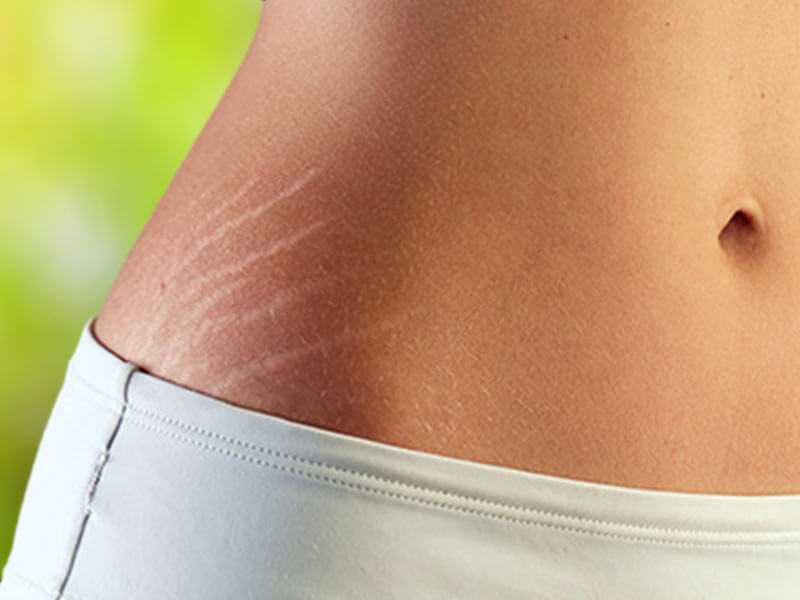

Stretch marks are linear bands that may develop when the skin undergoes rapid structural change. They are commonly associated with growth spurts, pregnancy, rapid changes in body size, and hormonal or genetic influences. Early stretch marks may appear red or purple and often become lighter or silvery as they mature.
Stretch marks commonly occur on the abdomen, hips, thighs, breasts, and other areas subject to rapid expansion. They are generally not dangerous to health by themselves, although they may cause cosmetic concerns.
Stretch marks are associated with changes in collagen, elastin, and other components of the dermal connective tissue. They are biologically different from conventional traumatic or surgical scars.
Causes of Stretch Mark Formation
Genetic predisposition, hormonal factors, rapid growth, pregnancy, and changes in body size can all contribute to the development of stretch marks. Adolescence is one common period because rapid growth and hormonal changes may occur simultaneously.
Pregnancy is another common setting in which stretch marks develop. Both mechanical stretching and hormonal influences are thought to contribute. Rapid increases in muscle mass may also be associated with their development.
Rapid weight gain or changes in body dimensions can also contribute. However, stretch marks should not be explained solely as a simple loss of elasticity.
Differences Between Scars, Wound Scars, and Stretch Marks
The terms scar and wound scar largely refer to the same general process of scar tissue formation after an injury, surgery, burn, or inflammation. Scars may be flat, raised, depressed, wide, pigmented, or contracted.
Stretch marks are different. They develop as striae within the dermal connective tissue and are not simply superficial wound scars.
Correctly identifying the type of skin change is important because stretch marks, hypertrophic scars, keloids, atrophic scars, and surgical scars may require different approaches.
Stretch Mark Treatment Methods
Several methods may be considered depending on the stage, color, location, and skin characteristics:
- Laser Treatment: Different laser technologies may target redness, pigment, or structural components of selected stretch marks and support remodeling.
- Microneedling: Controlled micro-injuries may stimulate a remodeling response that can reduce the visibility of selected stretch marks.
- Chemical Peeling: Chemical peels mainly affect superficial skin layers and may have a limited role in deeper established stretch marks.
Professional assessment can help determine which procedure may be appropriate for a particular individual.
Stretch Mark Treatment with Ankara Laser
Laser procedures for stretch marks are available in Ankara, but their suitability depends on the stretch mark stage, skin phototype, device, and treatment settings. Ankara Laser treatment should not automatically be described as universally safe or effective.
Several sessions may sometimes be considered, but there is no fixed number that applies to every person. Different lasers may target different aspects of early red stretch marks and mature white stretch marks.
After treatment, appropriate aftercare may include moisturization, gentle skin care, and ultraviolet protection according to the procedure. Recovery requirements vary according to the laser used.
Care After Stretch Mark Treatment
Aftercare should follow the treatment performed:
- Moisturizing: Appropriate moisturization may help support the skin barrier and reduce dryness but does not directly increase elasticity enough to remove stretch marks.
- Sun Protection: Recently treated skin may be more susceptible to ultraviolet-related irritation or pigment changes.
- Gentle Cleansing: Irritating exfoliation or strong active products may need to be temporarily avoided depending on the procedure.
These measures support recovery but cannot guarantee faster healing or a particular degree of improvement.
Frequently Asked Questions About Stretch Mark Treatment
- Do stretch marks completely disappear?
Complete disappearance is generally not expected. Treatment may make selected stretch marks less noticeable. - How long does treatment take?
Duration varies according to the method and individual response. Laser or microneedling plans may sometimes involve several sessions. - Are there side effects?
Yes. Redness, swelling, sensitivity, dryness, pigment changes, or other reactions may occur depending on the procedure. Side effects cannot universally be described as minimal.
Professional evaluation can help determine which approach is appropriate for the individual's stretch marks and skin characteristics.
 Call
Call
 Whatsapp