


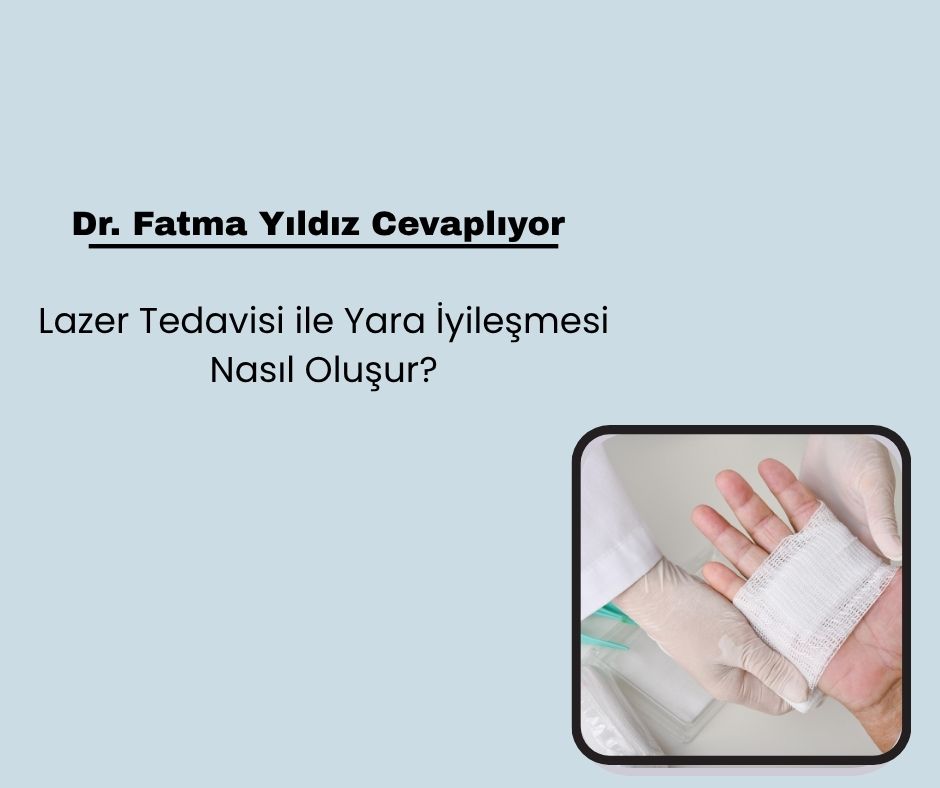

How Does Laser Treatment Heal Wounds?
The Alternative Approach of the Future
Wound healing is a complex process consisting of three basic phases: hemostasis and inflammation, proliferation and remodeling. This process progresses with the harmonious work of many cellular and biochemical factors such as platelets, neutrophils, fibroblasts, cytokines and free radicals. Collagen, especially synthesized by fibroblasts, plays a critical role in wound healing.
However, in some cases, this healing process may be interrupted. Wounds that do not close in more than four to eight weeks are called "chronic ulcers". These ulcers, which develop due to reasons such as diabetes, pressure sores, vascular insufficiency and burns, both reduce the quality of life and increase the cost of treatment. At this point, a new hope offered by modern medicine: laser treatment.
What is Laser and How Does It Work?
Laser (Light Amplification by the Stimulated Emission of Radiation) is an intense beam of light. It was first used in the 1960s in the field of dermatology and has become a reliable option in the treatment of many dermatological problems (scars, pigmentation disorders, vascular lesions, tattoos, etc.) today.
Although the effect of laser on wound healing has not been fully resolved, some biological mechanisms have been revealed in studies:
It increases cellular energy levels by increasing ATP (adenosine triphosphate) production.
It accelerates DNA and RNA synthesis.
It supports fibroblast proliferation.
It stimulates metabolism by increasing the permeability of the cell membrane.
It can reduce pain by triggering the release of endorphins and enkephalin.
Clinical Applications of Laser
The vast majority of studies on laser treatment have been conducted on animals or cell cultures. However, limited studies on humans have shown promising results.
Diabetic Foot Ulcer and Laser
Foot ulcers, which are frequently seen in diabetic patients, have shown significant shrinkage with low-intensity laser application. This situation reveals the positive contribution of laser in addition to classical treatment.
Pressure Sores
In patients with pressure ulcers who received laser treatments at different wavelengths (658 nm, 808 nm, 940 nm), it was observed that the 658 nm wavelength was more effective.
Venous Ulcers
In a randomized study using the 980 nm wavelength laser, although no significant reduction in ulcer diameter was achieved, positive developments such as pain control and complete healing were observed in some patients.
Other Application Areas
Laser treatment in recurrent oral aphthous ulcers both shortened the healing time and reduced pain.
In a patient with epidermolysis bullosa dystrophica, 70% healing was achieved within 4 weeks with fractional CO₂ laser application.
In children with neuropathic ulcers, significant reductions in wound diameter were observed with Nd:YAG laser application.
Things to Consider in Laser Wound Healing
Although laser treatment is a promising approach, there is currently no standard protocol regarding the most appropriate wavelength, laser type, application time and dose. Therefore, individual evaluation should be made for each patient and laser treatment should be considered as a complement, not a replacement for classical methods.
Conclusion
Laser treatment has the potential to be an alternative and effective method in wound healing, especially for chronic conditions. However, due to the small number and heterogeneity of human studies, more clinical data is needed. With comprehensive research to be conducted in the future, it may become possible to create standard protocols in this area.
While we continue to explore innovative treatment options, laser technology continues to shed scientific light on wound healing.
 Call
Call
 Whatsapp