


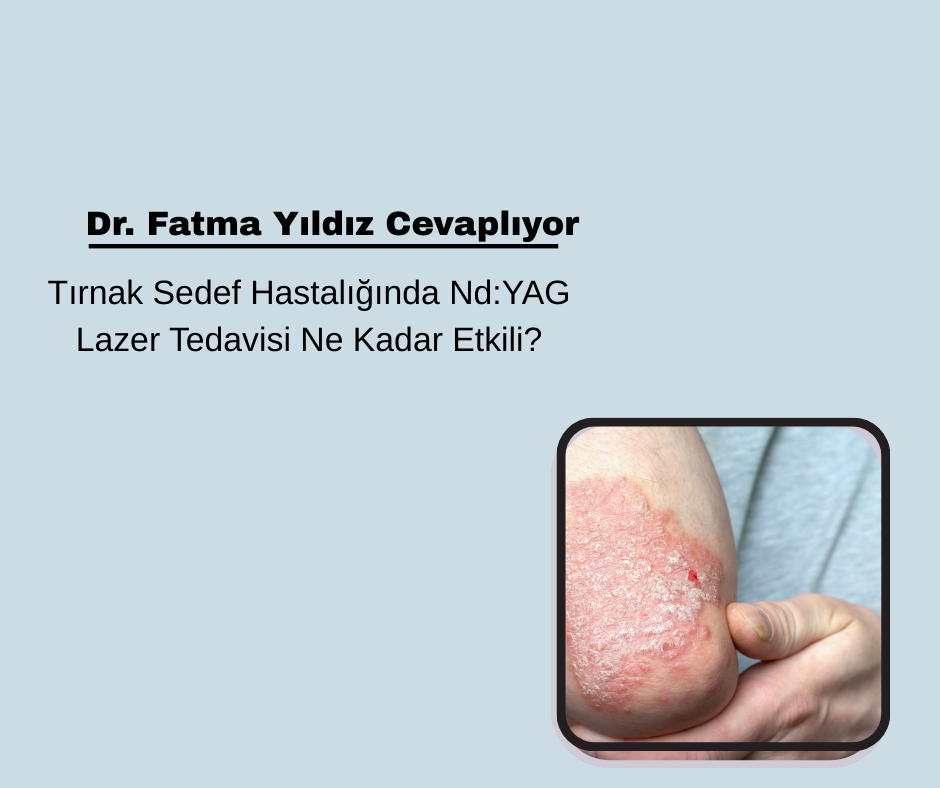

How Effective is Nd:YAG Laser Treatment for Nail Psoriasis?
Nail psoriasis is a chronic, inflammatory condition that can cause not only aesthetic but also functional and psychological problems. This condition, which occurs in fingernails and toenails, is associated with pain, breakage, deformities, loss of function, and a significant decrease in a person's quality of life. It is also linked to a more severe course of psoriasis and the risk of developing psoriatic arthritis.
Today, treating nail psoriasis is quite challenging. While topical medications, injections, and biological treatments can be used, delayed response to treatment and patient compliance issues complicate the process. Therefore, laser treatments have emerged as an important option in dermatology in recent years.
What is an Nd:YAG Laser and Why Is It Used?
The 1064 nm Nd:YAG laser is one of the most popular methods for treating nail psoriasis. This laser's working principle is "selective photothermolysis," which targets vascular structures and selectively affects hemoglobin. This can suppress excessive vascular formation and inflammation in the nail bed.
The 595 nm dye laser has also been used in the treatment of psoriasis, but its side effects, such as pain, bruising, and temporary scarring, are more pronounced. The Nd:YAG laser stands out as both an effective and tolerable option.
How Was the Study Conducted?
A recent intrapatient randomized controlled trial was conducted on 13 psoriasis patients and a total of 86 nails to evaluate the efficacy of the Nd:YAG laser.
Group A: Three sessions of Nd:YAG laser treatment were administered once a month.
Group B: The control group received no laser treatment.
Patients were evaluated at baseline and at 1 and 3 months post-treatment.
Assessment Methods:
tNAPSI score (Nail Psoriasis Severity Index – out of 32 points),
Expert dermatologist assessment using photography and dermoscopy,
Pain measurement (VAS scale),
High-frequency ultrasonography (nail plate, matrix, nail bed thickness, and vascular structures were examined).
What Did the Results Show?
At the end of follow-up:
✅ In the Nd:YAG laser group:
A significant decrease in tNAPSI scores,
A decrease in nail plate thickness,
A decrease in matrix and nail bed thickness,
A significant decrease in nail bed vascular density was observed.
✅ In the control group:
No significant improvement was observed in tNAPSI scores,
However, a decrease in some parameters (nail bed thickness and vascularity) was noted on ultrasound.
???? Important point: When comparing the groups, no significant difference was found in terms of clinical improvement. This reminds us that nail psoriasis can sometimes resolve spontaneously.
The Importance of Ultrasonography
Another prominent finding in the study is that ultrasound is a reliable monitoring method for nail psoriasis.
High-frequency ultrasound allows for the following:
Nail thickness,
Matrix changes,
Vascular density.
This allows for the detection of not only visible changes but also subclinical, early-stage changes.
Conclusion: Is Nd:YAG Laser Treatment Promising?
Nail psoriasis is a difficult condition to treat and significantly impacts quality of life. The long-pulsed 1064 nm Nd:YAG laser has demonstrated satisfactory results both clinically and ultrasonographically.
Reducing nail thickness,
Reducing vascular density,
Regressing subclinical changes are important advantages.
However, the observation of some improvements in the control group in the study reminds us that spontaneous resolution is possible in the natural course of the disease.
Therefore, rather than being a miraculous treatment on its own, Nd:YAG laser can be considered a powerful support method that can be combined with other treatments, depending on the patient's condition.
 Call
Call
 Whatsapp