


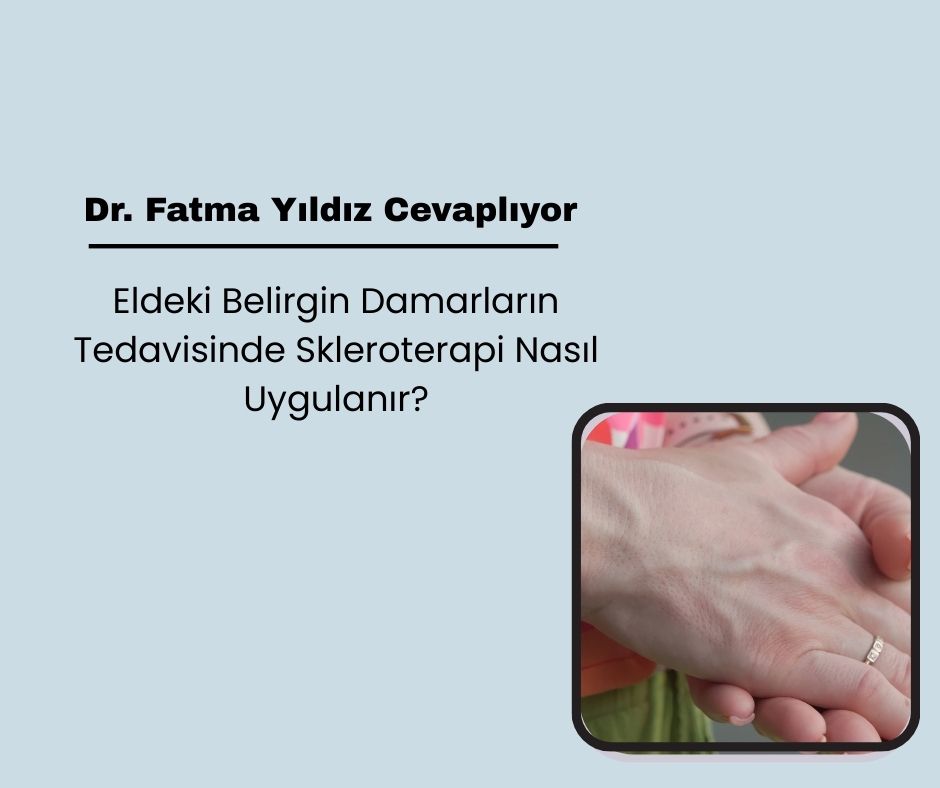

How is Sclerotherapy Applied in the Treatment of Visible Veins in the Hand?
Characteristic changes occur in the hands with the aging process. Over time, with the decrease in subcutaneous fat tissue, the veins, tendons and bone contours on the dorsum of the hand become more visible. At the same time, the skin loses its elasticity, the dermis thins and findings such as pigmentation irregularities, solar elastosis and telangiectasias may occur due to the effect of photoaging. This appearance can make a person look older than they are. In the literature, hand aesthetics are considered the second most important age indicator after the face.
What is Sclerotherapy?
Sclerotherapy is the process of injecting a sclerosing substance (in liquid or foam form) into unwanted veins, creating a chemical damage to the vein wall and thus permanently closing the vein. Over time, the vein turns into a fibrous structure and becomes invisible.
Sclerosing Agents Used
The most commonly used sclerosing agents:
Polidocanol (POL): A synthetic long-chain fatty acid with local anesthetic properties. It is used in the 0.25% - 4% concentration range. It usually provides painless injection.
Sodium tetradecyl sulfate (STS): A detergent used in 0.1% - 3% concentrations. It is FDA approved.
Alternative agents: Although in the background, glycerin, sodium morhuate and hypertonic saline solutions can also be used.
Advantages of Foam Sclerotherapy
The foam form is obtained by mixing the sclerosing agent with air. Thanks to this formulation:
Contact with the vascular wall increases,
Effective results are obtained with a smaller amount of the agent,
Homogeneous distribution is provided.
However, the foam form has the risk of air embolism, especially in patients with heart openings such as subclinical patent foramen ovale. This risk can be reduced by using carbon dioxide instead of air.
Treatment Procedure
The patient is placed on his/her back, the arm is positioned so that the hand is pronated and slightly flexed.
The sclerosing agent is injected with a 30 G needle at low pressure.
An average of 3-5 mL of the agent is used.
After the injection, the extremity is lifted, massaged and an elastic bandage is applied.
The bandage is kept for 24 hours.
1-3 sessions may be required if necessary.
Dosage Limitations
Polidocanol: Maximum 2 mg/kg
Sodium tetradecyl sulfate: 10 mL of 3% solution
Contraindications
Absolute contraindications:
Deep or superficial vein thrombosis
Active infection
Immobility
Hyperthyroidism with iodine-containing agents
First and last trimester of pregnancy
Allergy to sclerosants
Serious systemic diseases, heart defects
Relative contraindications:
Conditions such as thrombophilia, migraine, diabetes, asthma
Clinical Findings and Literature
Duffy et al.: 95% success reported in patients treated with 3% polidocanol.
Bowes and Goldman: 14 treated with 1.5-3% STS, 11 with complete vessel obliteration.
Tremaine et al.: 78.9% complete satisfaction was achieved in 21 patients with 0.25-1% STS foam.
Possible Complications
Hypopigmentation
Erythema, edema, pain
Telangiectatic matting
Ulceration, thrombus
Specific to foam form: transient visual changes, headache, neurological symptoms (very rare)
Conclusion
Sclerotherapy in hand rejuvenation aesthetics is an effective and safe method, especially in reducing the appearance of prominent superficial veins. With appropriate patient selection, experienced practitioner and correct agent dosage, the success rate is high. The recovery process after treatment is usually rapid and provides permanent aesthetic benefit.
 Call
Call
 Whatsapp