


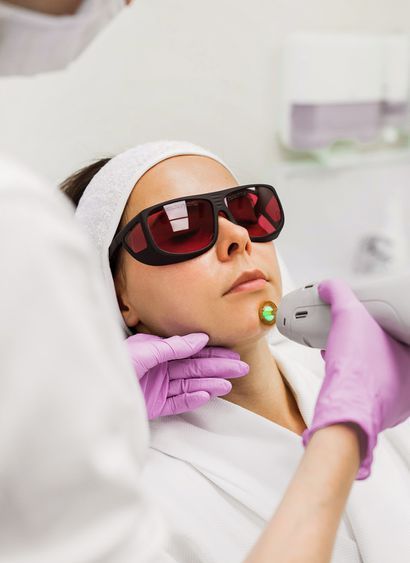

Laser hair removal focuses on the pigment (color substance) of the hair. The pigment absorbs light and creates heat at the hair root, thus damaging the hair root and preventing hair growth. In this way, the hair does not come back for a long time or grows thinner and sparser.
Laser hair removal can be applied to various parts of the body. Commonly used areas include legs, armpits, bikini area, face and back. A slight feeling of heat and redness may occur during the procedure, but it is usually at a tolerable level.
Effects of Laser Hair Removal and Shedding Process
Laser hair removal prevents the hair from coming back for a long time thanks to the damage it creates at the root of the hair. However, it takes time for the hair to fall out completely and for new hair to grow.
After laser hair removal, the hair shedding process usually takes place between 2-4 weeks. During this process, the hair begins to fall out naturally and a suitable environment is created for new hair to grow.
A significant decrease in hair is observed in the first few weeks. However, some hairs may be more resistant and will fall out later. Therefore, it can take 4-6 weeks for all hairs to fall out completely and for new hairs to grow.
The shedding process after laser hair removal can vary from person to person. Certain factors can affect the shedding process:
The thickness and density of the hair
The color of the hair (dark hairs fall out faster)
The area of the body (for example, legs fall out faster)
The person's skin and hair structure
The amount of laser energy applied
Depending on these factors, complete shedding of the hair and the growth of new hairs can vary between 2-6 weeks.
The Right Timing for Laser Hair Removal
During the laser hair removal process, it is important to treat the hairs at the right time and at regular intervals. In order to best target the hairs, the hairs must be in the active growth phase.
The active growth phase of the hair is the period when the hairs emerge from the root and grow rapidly. Since the hair root is most sensitive during this phase, laser energy can be applied most effectively to the hair root.
Laser hair removal sessions are usually performed at intervals of 4-8 weeks. This period allows the hair to regrow and enter the active growth phase. In this way, as many of the hairs as possible can be targeted in each session and more permanent results can be achieved.
Correct timing is very important in the laser hair removal process. Adjusting the time between sessions correctly allows the hairs to be targeted and shed in the most effective way. In this way, faster and more permanent hair reduction can be achieved.
Expectations for Shedding After Laser Hair Removal
After laser hair removal, the hair shedding process begins. Although this process varies from person to person, it usually occurs between 2-4 weeks.
A significant decrease in hair is observed in the first few weeks. However, it can take 4-6 weeks for all hairs to be completely shed and new hairs to grow.
Some hairs may be more resistant than others and will shed later. Therefore, it should not be expected that all hairs will shed equally. The shedding process may vary in different areas or people.
The shedding process after laser hair removal may vary depending on factors such as the person's hair structure, hair thickness and density, hair color, and the amount of laser energy applied.
Generally, a 20-30% reduction in hair can be observed after the first session. However, for complete permanent hair reduction, 4-6 laser hair removal sessions are usually required.
After each session, hair loss and new hair growth will be observed. Thus, hair reduction will increase with each session.
 Call
Call
 Whatsapp