


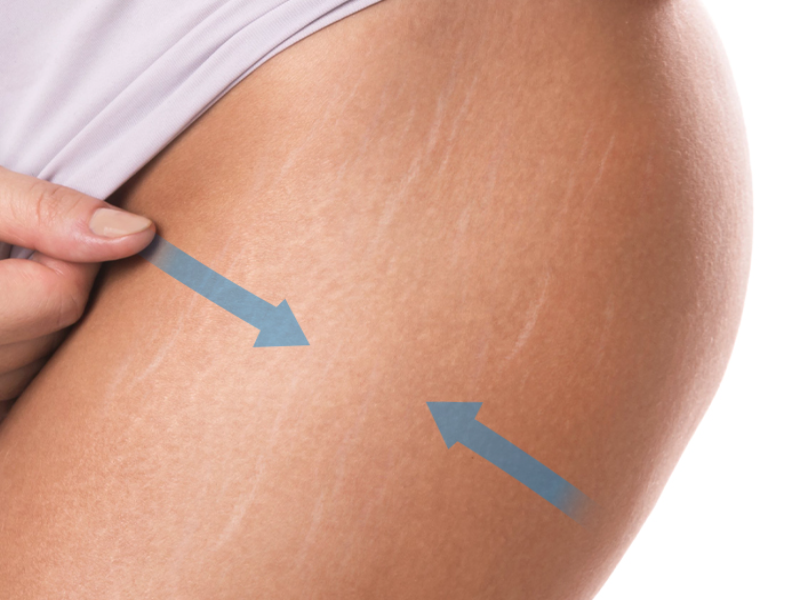

Stretch mark treatment includes different procedures intended to reduce the appearance of linear marks on the skin. The appropriate time to begin treatment is determined according to the colour of the stretch marks, how long they have been present, their location, the person’s skin structure, and their general health condition.
New red or purple stretch marks and older stretch marks that have turned white may not respond to treatment in the same way. However, the fact that stretch marks are in an early stage does not mean that they can always be completely eliminated. The main purpose of treatment is to reduce their appearance and make the difference between the stretch marks and the surrounding skin less noticeable.
What Are Stretch Marks and Why Do They Form?
Stretch marks, medically known as striae, are changes that occur in the dermal layer of the skin as a result of rapid stretching or hormonal changes affecting the skin structure. They are commonly associated with rapid weight gain or loss, pregnancy, rapid growth during puberty, and sudden increases in muscle volume.
When stretch marks first form, they may appear red, pink, or purple. This stage is considered the early stage of stretch marks. As vascular visibility decreases over time, the marks may become lighter, white, or silvery. Stretch marks at this stage are considered more mature.
Genetic predisposition and skin structure may also influence their formation. Of two people who experience a similar degree of weight change or skin stretching, only one may develop noticeable stretch marks. Hormonal changes, long-term or uncontrolled corticosteroid use, and certain health conditions may also affect the skin structure.
A balanced diet and adequate fluid intake may contribute to supporting general skin health. However, it cannot be stated that a particular diet, moisturiser, or level of water consumption will definitely prevent stretch marks.
How Should the Right Time for Stretch Mark Treatment Be Selected?
When determining the appropriate period for stretch mark treatment, not only the season but also the developmental stage of the stretch marks and the person’s health condition should be evaluated.
Newly Formed Stretch Marks
New stretch marks that are red, pink, or purple may respond earlier to certain treatment methods. At this stage, vascular structures may be more visible, and the selected method may be planned to target both colour differences and changes in texture.
An early assessment may be beneficial when new stretch marks are noticed. However, whether treatment can begin immediately depends on factors such as pregnancy, breastfeeding, medications being used, active skin conditions, and sensitivity in the area.
Older White Stretch Marks
White or silvery stretch marks are considered more mature. Treatment plans for these marks generally target skin texture and the surface appearance of the stretch marks.
Procedures may still be performed to reduce the appearance of older stretch marks. However, more sessions or a combination of methods may be required. The degree of change varies from person to person.
Pregnancy and Breastfeeding
Procedures for stretch marks that form during pregnancy are generally postponed until after pregnancy. During breastfeeding, the products, anaesthetic substances, and treatment methods to be used should also be evaluated.
Allowing body weight and hormonal changes to stabilise to some extent after childbirth may help create a more appropriate treatment plan. The suitable time should be determined by a healthcare professional according to the individual’s condition.
Periods of Continuing Weight Change
New stretch marks may form while rapid weight gain or loss continues. Therefore, treatment may preferably be planned during a period when body weight is more stable.
However, this does not mean that assessment of existing stretch marks must always be postponed until weight changes have completely stopped. Treatment timing should be determined individually.
Periods of Intense Sun Exposure
The skin may become more sensitive to sunlight after certain laser, peeling, and similar skin-renewal procedures. When the treated area is exposed to sunlight, the risk of changes in skin colour may increase.
For this reason, the person’s holiday plans, tanning habits, and whether the treatment area is exposed to sunlight should be considered. Periods when sun protection is easier may be preferred for certain procedures.
Methods Used in Stretch Mark Treatment
The method used in stretch mark treatment is determined according to the colour and depth of the stretch marks, their location, and the person’s skin type. A single method may not be suitable or sufficient for everyone.
Laser Applications
Fractional lasers and laser systems with different wavelengths may be used to reduce colour and texture differences associated with stretch marks. The appropriate device and energy setting should be selected according to the person’s skin tone and the developmental stage of the stretch marks.
Temporary redness, sensitivity, crusting, or changes in skin colour may occur after laser treatment. Because not every laser system is suitable for every skin type, a detailed assessment is required before the procedure.
Microneedling
Microneedling is performed by creating controlled microchannels in the skin. It aims to support the skin’s natural repair process and reduce the difference in texture caused by stretch marks.
Redness and sensitivity may occur after the procedure. The treatment depth and intervals between sessions should be planned according to the treated area.
Radiofrequency Microneedling
Radiofrequency microneedling involves delivering controlled energy to selected layers of the skin through microneedles. It may be considered as one of the options for reducing differences in the texture of stretch marks.
Its suitability is determined by considering the person’s skin type, the location of the stretch marks, and their health condition.
Chemical Peeling
Chemical peeling may be used in selected cases to help reduce differences in skin colour and texture. The type and concentration of acid should be selected carefully according to the treatment area.
Unsupervised use of acid-containing products at home may cause irritation, burns, pigmentation changes, and damage to the skin barrier.
Microdermabrasion
Microdermabrasion is a mechanical procedure targeting the outermost layer of the skin. It may be considered as a supportive method for superficial differences in texture. It may not provide sufficient improvement on its own for deep and mature stretch marks.
PRP and Mesotherapy
PRP treatment uses platelet-rich plasma obtained from the person’s own blood. In some treatment plans, it may be considered as a supportive procedure alongside methods such as microneedling or laser treatment.
In mesotherapy, different substances are injected beneath the skin. The ingredients used and the effectiveness of this method in treating stretch marks may vary. These procedures should be planned following an individual assessment.
No method can guarantee that stretch marks will completely disappear. The purpose of treatment is to make differences in colour and texture less noticeable.
Differences Between Scars, Wound Scars, and Stretch Marks
Although the terms scar, wound scar, and stretch mark are sometimes used interchangeably, their mechanisms of formation are different.
Scars and Wound Scars
A scar is tissue that forms during the healing process after the skin has been cut, burned, operated on, or otherwise injured. Its appearance may vary according to the depth of the wound, the way it healed, whether an infection developed, and the person’s genetic characteristics.
Some scars may be depressed, raised, firm, or different in colour from the surrounding skin. The treatment approach is determined according to the type of scar.
Stretch Marks
Stretch marks generally form without an open wound or cut as a result of rapid stretching and structural changes in the dermal layer. They appear as parallel or irregular lines on the skin surface.
Although stretch marks may be considered a type of dermal mark, they do not have the same treatment approach as surgical scars. Correct identification is therefore important when selecting an appropriate method.
Laser Stretch Mark Treatment in Ankara
People considering laser stretch mark treatment in Ankara should first undergo a skin assessment. A personalised plan may be created by evaluating the colour and depth of the stretch marks, their location, the person’s skin tone, and previously performed treatments.
Following an assessment at Ankara Life Polikinlik, the suitability of laser and other skin-renewal methods may be reviewed. The device, treatment settings, number of sessions, and intervals between sessions may vary from person to person.
Laser stretch mark treatment does not require a surgical incision. However, redness, sensitivity, swelling, crusting, or temporary changes in colour may occur after treatment. The recovery period varies according to the system used and the intensity of the procedure.
The complete disappearance of stretch marks should not be expected after treatment. The aim is to reduce differences in colour and texture between the stretch marks and the surrounding skin.
Points to Consider Before Stretch Mark Treatment
Before treatment begins, the person’s health condition, medications, skin conditions, and previous procedures should be evaluated.
The healthcare professional should be informed if any of the following are present:
-
Pregnancy or breastfeeding
-
An active skin infection
-
Open wounds, eczema, or significant irritation
-
A tendency to develop keloids
-
Bleeding or clotting disorders
-
Regularly used medications
-
Recent sun exposure or tanning-bed use
-
Previous laser, peeling, or injection procedures
-
Uncontrolled hormonal or systemic health conditions
Rather than relying on vague professional titles such as “aesthetic specialist,” it is important for the procedure to be planned under the assessment and supervision of an authorised healthcare professional.
Possible Benefits of Stretch Mark Treatment
Stretch mark treatment may help make differences in colour and texture less noticeable. The degree of change varies according to the characteristics of the stretch marks and the method used.
Changes in appearance may help some people feel more comfortable. However, the psychological effect of the procedure and its effect on self-confidence are not the same for everyone.
Certain procedures may help the skin texture in the treated area appear more even. However, it cannot be guaranteed that the skin will become completely smooth, younger-looking, or return to its condition before the stretch marks formed.
Care After Stretch Mark Treatment
Post-treatment care varies according to the method used. The instructions provided by the healthcare professional who performed the procedure should be followed.
The following precautions may be necessary after treatment:
-
Keeping the treated area clean and dry
-
Using recommended moisturisers or care products
-
Providing appropriate sun protection for exposed areas
-
Avoiding picking at crusts or scratching the skin
-
Avoiding exfoliants and products that may irritate the skin
-
Avoiding saunas, steam rooms, and intensive exercise for the recommended period
-
Not using oils, creams, or homemade mixtures that have not been recommended by the specialist
Moisturiser may help manage dryness and tightness after treatment. However, moisturisers cannot be said to prevent the formation of new stretch marks with certainty.
The healthcare professional who performed the procedure should be contacted if severe pain, increasing redness, blistering, open wounds, discharge, signs of infection, or unexpected changes in skin colour develop.
The outcome of stretch mark treatment does not depend solely on post-procedure care. The structure of the stretch marks, skin type, selected method, and the person’s response to treatment also affect the result. Regular follow-up appointments may help monitor the process and allow the treatment plan to be reassessed when necessary.
 Call
Call
 Whatsapp