


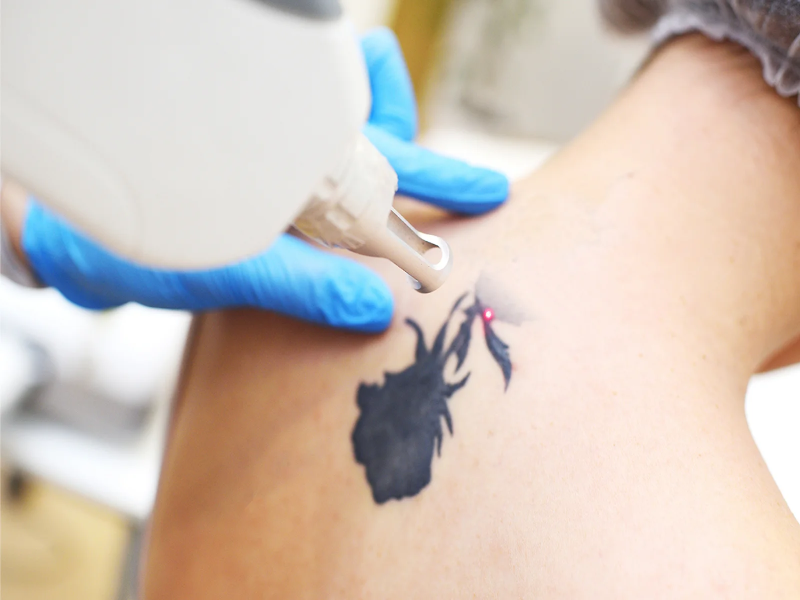

Getting a tattoo is making a permanent change in our lives. However, over time, due to personal preferences or professional requirements, we may want to get rid of tattoos. The question of in which situations laser tattoo removal is preferred becomes important at this point. In this article, we will discuss everything you need to know about the laser tattoo removal process.
What Is Laser Tattoo Removal?
Laser tattoo removal is a procedure in which high-energy laser beams are used to break down tattoo ink. This method targets the tattoo pigments under the skin and allows them to break apart, and the body eliminates these particles naturally. Thanks to laser technology, tattoos can be effectively removed without leaving permanent damage on the skin.
Laser tattoo removal is performed using lasers with different wavelengths. Each wavelength targets tattoo inks in specific colors. For this reason, removing multicolored tattoos usually requires several different laser applications. With the development of technology, laser tattoo removal procedures have become faster and more effective.
This method is considered one of the most effective and safe methods among tattoo removal procedures. Laser beams target only the tattoo ink and do not damage the healthy tissues around the skin. This minimizes the risk of scarring on the skin.
In Which Situations Is Laser Tattoo Removal Preferred?
The question of in which situations laser tattoo removal is preferred is important for many people. Tattoos may become unwanted over time for various reasons. Here are these situations:
Personal Preferences and Changes: Over time, the meaning of your tattoo may change or you may no longer like that design. As our personal tastes change, the tattoo may not keep up with these changes.
Professional Requirements: Some occupational groups may require their employees not to have tattoos. Especially in corporate and official environments, tattoos may be unwanted. In such cases, laser tattoo removal may be a good solution.
Incorrectly Made Tattoos: Mistakes encountered while getting a tattoo or unwanted results may lead tattoo owners to remove them with this method. Misspelled names or faulty designs fall into this category.
Apart from these situations, tattoo removal may also be preferred due to health problems or allergic reactions. In every case, it is important for the person to evaluate whether they are a suitable candidate for laser tattoo removal.
Advantages of Laser Tattoo Removal
Laser tattoo removal has many advantages. First, this method is quite safe. Laser technology targets only the tattoo ink and does not damage the surrounding skin tissue. This speeds up the healing process and reduces the risk of infection.
Another advantage is that the laser tattoo removal procedure is effective. Tattoo ink is broken down by laser beams and eliminated naturally by the body. Therefore, tattoos can usually be completely removed after a few sessions. Especially in dark-colored tattoos, the laser procedure gives quite successful results.
Finally, the laser tattoo removal procedure can be planned individually. Different laser types and numbers of sessions are determined according to the color and size of the tattoo and the person’s skin structure. This personalized approach allows the best results to be achieved.
How Does the Laser Tattoo Removal Process Work?
The laser tattoo removal process consists of a series of steps, and each step is carefully planned. First, a consultation is held with a dermatologist or specialist doctor. During this consultation, the color and size of your tattoo and your skin type are evaluated. In addition, your health history and expectations are also taken into consideration.
Then, a treatment plan is created for the laser tattoo removal procedure. This plan determines how many sessions are needed according to the color and size of the tattoo. Usually, several sessions are required before the tattoo is completely removed. Between sessions, a certain period of time is allowed for the skin to heal.
During each session, the laser device is directed onto the tattoo and sends short bursts of light. A mild discomfort may be felt during this procedure, but it is generally at a tolerable level. After the procedure, mild redness and swelling may occur on the skin, but these side effects usually disappear in a short time.
Who Are Suitable Candidates for Laser Tattoo Removal?
The laser tattoo removal procedure may not be suitable for everyone. For this method to be successful, certain criteria must be met. First, the person’s general health condition should be good. Especially people who have skin problems or allergic reactions should consult their doctors before having this procedure.
The color and depth of the tattoo are also important factors. While dark-colored tattoos can be removed more easily with laser, light-colored tattoos may require more sessions. In addition, the skin structure in the area where the tattoo was made may also affect the success of the procedure.
Finally, suitable candidates for laser tattoo removal are people who can patiently follow the procedure process and the recovery process afterward. It may take time for the results to be fully seen, and during this process, it is important to follow the treatment plan.
Things to Consider After Laser Tattoo Removal
After the laser tattoo removal procedure, certain precautions should be taken for the skin to heal. First, applying a cold compress may be beneficial for redness and swelling that may occur on the skin after the procedure. This reduces the feeling of discomfort and speeds up the healing process.
Second, it is important to keep the treated area clean and dry. The skin may be sensitive during its natural healing process, and hygiene rules should be followed to reduce the risk of infection. In addition, using a high-factor sunscreen is recommended to protect from sun rays.
Finally, after the laser tattoo removal procedure, flaking or crusting may be seen on the skin. This condition is normal and shows that the skin is healing. However, these crusts should not be picked, because this may cause scarring on the skin.
Frequently Asked Questions About Laser Tattoo Removal
1. Does laser tattoo removal hurt?
During the laser tattoo removal procedure, mild discomfort may be felt. However, this feeling is usually at a tolerable level, and discomfort can be minimized with cooling systems used during the procedure.
2. Can the tattoo be completely removed?
Whether the tattoo can be completely removed depends on the color and depth of the tattoo and the type of ink used. Generally, dark-colored tattoos are removed more easily, while light-colored tattoos may require more sessions.
3. How many sessions does laser tattoo removal require?
The duration of the procedure and the number of sessions vary according to the size and color of the tattoo and skin type. Generally, several sessions may be required for the tattoo to be completely removed. A certain period of time is allowed between each session for the skin to heal.
 Call
Call
 Whatsapp