


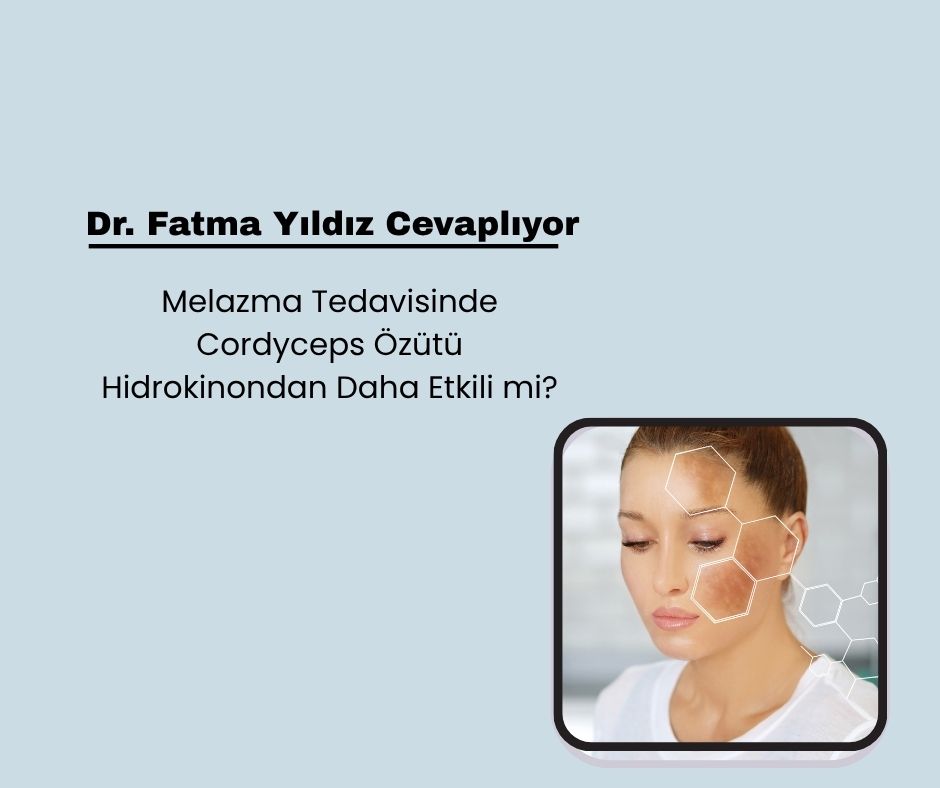

Is Cordyceps Extract More Effective Than Hydroquinone in Treating Melasma?
Melasma is an aesthetically displeasing skin condition characterized by symmetrical, brown, and irregular patches, particularly on the face. It occurs in sun-exposed areas and most commonly affects women in their 30s and 40s, particularly those of Asian descent. While not life-threatening, it can affect a person's psychological well-being, causing anxiety, depression, and loss of self-confidence.
In recent years, skin-whitening cosmetics developed with natural ingredients have emerged as an alternative to conventional treatments like hydroquinone. So, could a natural product containing Cordyceps extract be effective in treating melasma? Let's explore this question together in light of a clinical study conducted in 2023-2024.
What Are the Causes and Treatment Challenges of Melasma?
Melasma is an acquired pigmentation disorder that develops under the influence of various factors, including sunlight, hormonal changes, and genetic predisposition. Pregnancy, birth control pills, and UV rays are among the triggers of this condition.
Topical agents (medications applied to the skin) are generally the first line of treatment. Hydroquinone, one of the most commonly used, lightens skin tone by suppressing pigment production. However, with long-term use, undesirable effects such as:
Contact dermatitis
Excessive skin whitening (depigmentation)
Exogenous ocheronosis
can occur. This has led to the search for safer and natural alternatives.
What is Cordyceps Extract and How Does It Work?
Cordyceps is a natural ingredient of fungal origin that has been used in traditional Chinese medicine for many years. In skincare, it can specifically:
Its melanin-reducing effect
Thanks to its antioxidant and anti-inflammatory properties, it can address various pathological aspects of melasma.
Therefore, Cordyceps extract, combined with other effective ingredients such as arbutin, nonapeptide-1, and glabridin, has become a promising formula for next-generation melasma treatments.
How Was a Trial Conducted Comparing Cordyceps Extract and Hydroquinone?
In a randomized controlled trial conducted in China between 2023 and 2024, 62 women with melasma were divided into two groups:
Group A: Topical hydroquinone cream + oral tranexamic acid (TXA)
Group B: Topical Cordyceps extract + oral TXA
Both groups were treated for 12 weeks. Assessments were made at weeks 0, 4, 8, and 12. The following measurement tools were used:
MASI score: Assessment of melasma area and severity
Melanin and erythema index: Measured with a Mexameter
A patient satisfaction survey and monitoring of potential side effects were also administered.
What Did the Treatment Results Show?
The study's findings were striking:
Melasma symptoms improved in both groups.
Patients using Cordyceps extract experienced lower MASI scores, a reduction in melanin index, and higher patient satisfaction rates.
Side effects such as itching, flaking, and skin sensitivity were observed more frequently in the hydroquinone group.
Side effects were minimal in the Cordyceps group, providing an advantage for long-term use.
Furthermore, metabolomic analyses performed in this group revealed that Cordyceps extract reduced pigment production by affecting certain metabolic pathways related to melanin synthesis in the skin.
Is Cordyceps Extract Really Safe?
No serious adverse effects were observed in the Cordyceps extract group during the study. Safety was further enhanced by a small area allergy test performed before use.
Other active ingredients in the Cordyceps extract product are also noteworthy:
Arbutin (0.5%): A natural substance that evens skin tone.
Nonapeptide-1 (3%): Has a melanin production-inhibiting effect.
Glabridin (3%): It exhibits anti-inflammatory properties and can reduce pigmentation.
This combination targets both the pigmentation and inflammation aspects of melasma.
Which is the Best Treatment for Melasma?
The results indicate that natural topical products containing Cordyceps extract can be an effective and safe alternative, especially for individuals who are intolerant to hydroquinone or who are not at risk of long-term use.
There is no single miracle product for melasma treatment. Many factors, including skin type, spot depth, hormonal status, and UV exposure, influence treatment planning. Therefore:
Dermatologist supervision,
Combination treatments (e.g., supplementation with TXA, laser, chemical peels),
Sun protection,
are key factors determining treatment success.
Conclusion: Is Cordyceps Extract Launching a New Era in Melasma Treatment?
Research indicates that topical products containing Cordyceps extract can be an alternative to hydroquinone in terms of both efficacy and safety. With its natural ingredients and low side effect profile, it holds promise for long-term use in chronic pigmentation disorders such as melasma.
However, further studies with larger patient groups will confirm the generalizability of these findings.
 Call
Call
 Whatsapp