


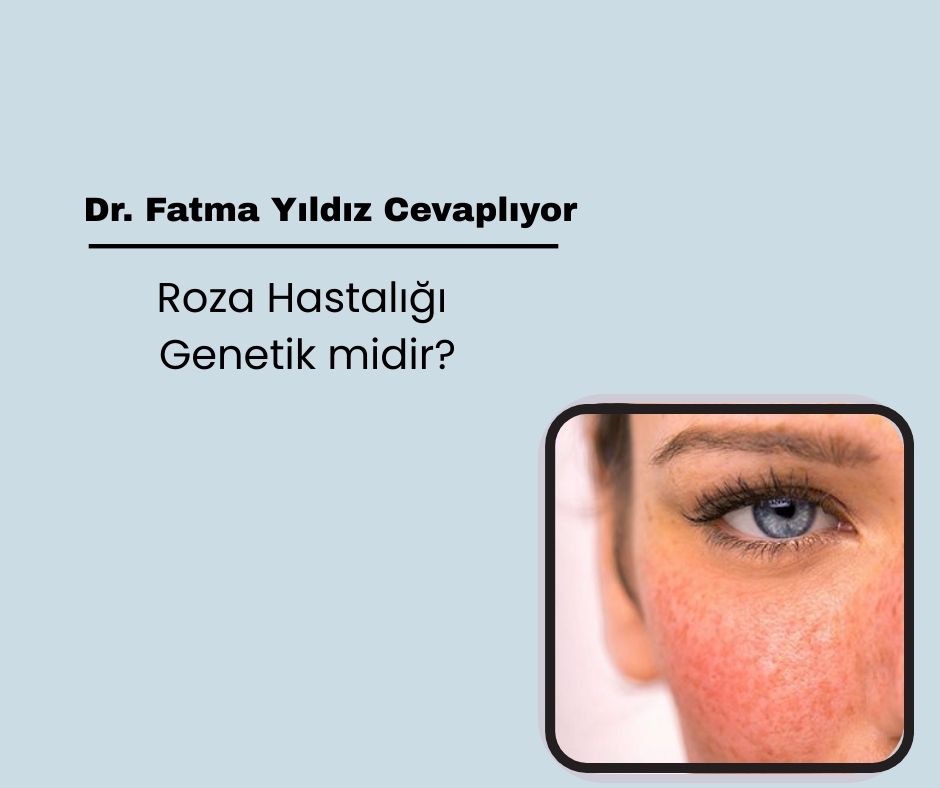

Is Rosacea Genetic? | Doctor Fatma Yıldız provides information about the genetic predisposition in my rosacea disease and diseases associated with rosacea
Rosa disease (rosacea) is a chronic and inflammatory skin disease that can develop under the influence of genetic factors. The fact that it is frequently seen in individuals with fair skin and colored eyes, and that family history affects up to 40%, supports genetic predisposition.
The role of genetics in rosacea pathophysiology first came to the agenda in 2007 with the observation of rosacea cases in monozygotic twins.
Large-scale genome studies conducted in recent years have revealed the relationship between rosacea and two different single nucleotide polymorphisms (SNPs) [rs763035 and rs111314066]. In particular, it has been confirmed that the rs763035 polymorphism is located between the Butyrophilin-Like 2 (BRNL2) and Human Leukocyte Antigen (HLA)-DRA gene regions and that this region may be effective in the development of rosacea.
In immunohistochemical analyses, a strong labeling was observed in perifollicular inflammatory infiltrate, Langerhans cells and endothelial cells in staining with antibodies against HLA-DRA. Similarly, BRNL2 antibodies showed intense positivity in keratinocytes and inflammatory infiltrates.
In addition, the Major Histocompatibility Complex (MHC) class II alleles, HLA-DRB1, HLA-DQB1 and HLA-DQA1 genes, have also been associated with rosacea.
In another genetic analysis, it was determined that the Glutathione S-Transferase (GST) polymorphism may play a role in the development of rosacea. The presence of GSTT1 and GSTM1 genotypes increases oxidative stress by causing the accumulation of reactive oxygen species (ROS), which triggers rosacea.
In a patient with granulomatous rosacea, the R702W polymorphism was detected in the NOD2/CARD15 gene, which plays an important role in inflammation. This gene contributes to the inflammatory response through the Toll-like receptor (TLR).
In addition, the rs3733631 polymorphism in the tachykinin receptor gene TACR3, located near the TLR2 gene, increases TLR2 expression and thus supports the development of rosacea.
Although all these findings suggest that genetic factors may be effective in rosacea, a definitive relationship between rosacea and genetics has not been proven to date.
Associated Diseases in Rosacea
In addition to genetic predisposition, connections have been established with many systemic diseases in patients with rosacea. The HLA-DRA locus in particular has been associated with inflammatory bowel diseases (ulcerative colitis, Crohn's disease, celiac disease).
It is thought that the presence of inflammation in the intestinal system may increase the risk of rosacea.
It has also been reported that cardiovascular diseases such as hypertension, dyslipidemia and coronary artery disease are seen at higher rates in rosacea patients. This relationship is explained by the low paraoxonase-1 levels observed in patients with rosacea and dyslipidemia and the increased cathelicidin expression in both diseases.
The finding of common genetic regions with rosacea in patients with Type 1 Diabetes Mellitus suggests that insulin resistance may be effective in rosacea. There are also studies showing the relationship between metabolic syndrome and increased glucose intolerance and rosacea. These connections also include the effects of oxidative stress and endoplasmic reticulum stress.
An increase in neurological diseases such as migraine, depression, complex regional pain syndrome and glioma, and neurodegenerative disorders such as Parkinson's disease and dementia have been observed in individuals with rosacea. This relationship is associated with increased expression of matrix metalloproteinase (MMP), which is a common mechanism in rosacea and neurological diseases.
In summary:
Genetic predisposition is a strong risk factor in rosacea, but it is not sufficient on its own.
Environmental factors, immune system disorders and systemic diseases also contribute to the development of rosacea.
Although genetic links are strong, rosacea is not considered a completely genetic disease today.
 Call
Call
 Whatsapp