


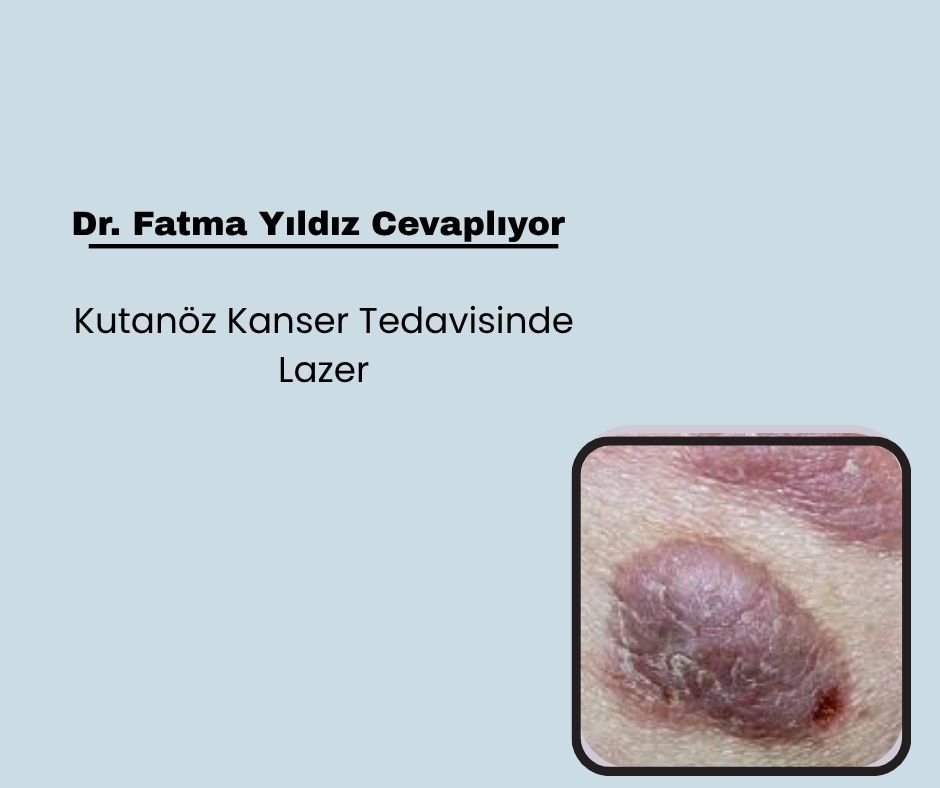

Laser in Cutaneous Cancer Treatment
Effectiveness, Methods and Ankara Life Polyclinic Approach
Cutaneous cancers, namely skin cancers, are one of the most common malignancies encountered in dermatology practice. Today, with the development of laser technologies, lasers stand out as an important alternative in the treatment of such skin cancers. Laser treatment offers successful results, especially in patients who are not suitable for surgical treatment or in cases where cosmetic concerns are at the forefront.
Laser Basal Cell Carcinoma (BCC) Treatment
Basal cell carcinoma is the most common type of skin cancer. Laser treatment is successfully used in this disease at different wavelengths.
Nd:YAG Laser (1064 nm): With the Nd:YAG laser applied in continuous wave form, 97.3% of 37 patients were completely cured, and only 2.7% recurrence was observed after 3-5 years. In addition, 92% complete response was achieved with single-session treatment in small (<1.5 cm) lesions located on the trunk and extremities.
Combined Laser Treatment (Nd:YAG + PDL): In the treatment where pulsed dye laser (PDL) and Nd:YAG laser were combined, complete response was observed in 58% of the patients; anticoagulant use was noted in cases where no response was obtained.
Er:YAG Laser (2940 nm): Compared to photodynamic therapy (PDT), Er:YAG laser alone achieved 91.75% success; in combined use, the success rate reached 98.97%. Cosmetic satisfaction rate is also quite high.
CO2 Laser (10600 nm): No recurrence was observed in 140 BCC cases treated with superpulse CO2 laser for 3 years. It has been reported that it is effective even in periorbital nodular lesions. In addition, it has been reported that clinical results are even improved with the combined use of fractional CO2 laser and PDT.
Laser Squamous Cell Carcinoma (SCC) Treatment
Squamous cell carcinoma is a more aggressive type of skin cancer. Laser treatments are especially important for patients who cannot undergo surgery.
Nd:YAG Laser: In patients with stage 1 lip SCC, 82.6% recurrence-free rate was reported after 5 years, and cosmetic results were found to be excellent.
Pulse Dye Laser (PDL): 71% success was achieved in the single-shot group and 25% in the two-shot group. These results show that even PDL can be used in the treatment of SCC, albeit to a limited extent.
CO2 Laser: 100% success was achieved with the use of CO2 laser in superficial BCC and in situ SCC lesions. However, the success rate decreases in invasive SCC, and it has been emphasized that laser should only be preferred in patients who cannot undergo surgery in these cases.
Mycosis Fungoides (MF) and Laser Applications
The most commonly used laser in the treatment of early-stage mycosis fungoides is the 308 nm excimer laser. This method provides effective results in cases resistant to topical treatment.
In various studies, 86% complete response was achieved with excimer laser, and success was found to be higher especially in patch and plaque type lesions.
Excimer laser, which is more practical compared to PUVA treatment, offers advantages in terms of shorter session intervals and not requiring the use of psoralen.
However, due to the limited number of data and lack of long-term follow-up, excimer laser is not yet recommended as a first-line treatment.
Conclusion
Laser treatment of cutaneous cancers is a promising method, especially in patients who avoid surgery. Different laser systems such as Nd:YAG, CO2, Er:YAG and Excimer are successfully applied for different types of skin cancer.
As Ankara Life Polyclinic, laser treatments we perform under the leadership of Dermatology Specialist Fatma Yıldız are applications based on scientific data, safe and prioritize patient comfort. In this article, we present a scientifically based review of laser cutaneous cancer treatment.
 Call
Call
 Whatsapp