


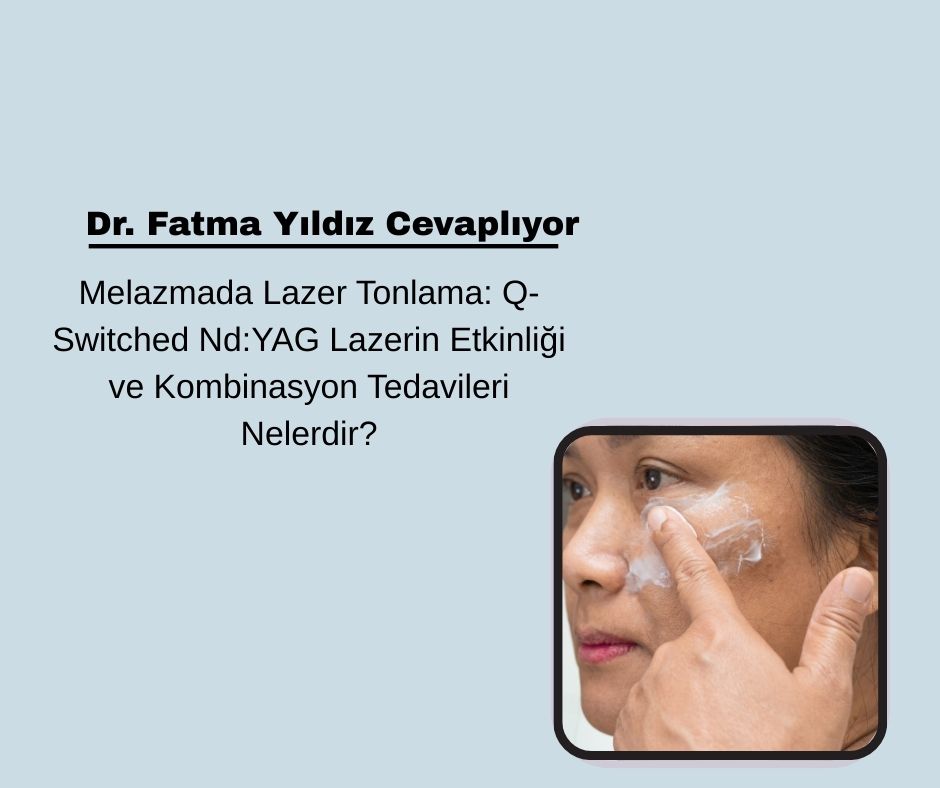

Laser Toning for Melasma: What are the Effectiveness of the Q-Switched Nd:YAG Laser and Combination Treatments?
Melasma is a chronic skin condition characterized by symmetrical hyperpigmented patches on the face, particularly common in adult women and those with darker skin types (Fitzpatrick phototypes III–V). It causes not only aesthetic but also significant psychosocial difficulties for patients. Due to its refractory nature, frequent recurrences, and sometimes post-treatment worsening, it is considered one of the most challenging pigmentation diseases for dermatologists.
While topical combinations (hydroquinone, tretinoin, corticosteroids) have been used for many years in conventional treatment, the effects can be temporary, and relapses are common. While laser treatments were long considered contraindicated, in recent years, the low-flux Q-Switched Nd:YAG laser (LFQSNY), commonly known as "laser toning," has become a prominent method in the treatment of melasma.
Pathogenesis and Challenges of Melasma
The mechanism of melasma formation has not been fully elucidated. However, the following factors are known to play a role:
Chronic sun exposure
Hormonal changes (pregnancy, birth control pills)
Genetic predisposition
Dermal inflammation and photoaging
Histological examinations show that melasma is not merely a pigmentary disorder but also a complex dermal change associated with photoaging. In addition to melanocyte overactivity, the condition is also accompanied by solar elastosis in the dermis, increased vascular density, mast cell proliferation, and basement membrane changes.
Therefore, melasma is difficult to treat, and the results are often temporary and variable.
What is Laser Toning (LFQSNY)?
Laser toning, which has become popular especially in Asia since the 2000s, is the application of a low-fluence, multiple-session Q-Switched Nd:YAG laser.
Wavelength: 1064 nm
Energy density: 1–3 J/cm²
Spot size: 6–10 mm
Frequency: 5–10 Hz
Session interval: 1–2 weeks
Total sessions: Average 8–10
The treatment aims to produce mild erythema. This means that no energy is applied that would overheat the skin.
Mechanism
LFQSNY works on the principle of "subcellular selective photothermolysis." This means it breaks down melanosomes containing melanin but does not damage melanocyte cells. This results in:
Pigment reduction,
Skin tone brightening,
The epidermis remains intact.
The greatest advantage is that it requires no recovery time, allowing patients to return to their daily lives immediately.
The Effectiveness of LFQSNY
Various clinical studies have shown that LFQSNY is safe and effective in treating melasma.
Subjective Measurements: Patient self-assessments and photo comparisons generally yielded positive results.
Objective Measurements: Significant reductions were observed in MASI (Melasma Area Severity Index), mMASI, melanin index (MI), and erythema index (EI) scores.
However, the effectiveness level may vary depending on the number of sessions, application interval, and the patient's skin type.
Side Effects and Limitations
LFQSNY is generally well tolerated. The most common side effects are:
Transient erythema (redness)
Edema
Rarer but significant complications include:
Mottled hypopigmentation (MH)
Rebound hyperpigmentation (RH)
These side effects have been reported more frequently, particularly in darker skin types. Furthermore, some patients experience recurrence of melasma several months after treatment is discontinued.
LFQSNY and Combination Treatments
LFQSNY as monotherapy can alleviate melasma, but the recurrence rate is high. Therefore, combination treatments are increasingly preferred today.
Energy-Based Combinations
When applied in conjunction with fractional CO₂ or Er:YAG laser, pigment reduction is enhanced and the risk of MH is reduced.
The combination of fractional microneedling with radiofrequency (FMR) has been found to be more effective than LFQSNY alone, with a lower rate of side effects.
The combination with PDL (Pulsed Dye Laser) is particularly effective in melasma with prominent vascularity.
The combination with IPL (Intense Pulsed Light) is one of the most effective alternatives for melasma treatment.
Non-EBD Combinations
Chemical peels (glycolic acid, Jessner solution): Support LFQSNY in pigment reduction.
Topical treatments (hydroquinone, azelaic acid, arbutin, silymarin): Increase effectiveness.
When combined with oral tranexamic acid (TXA), the recurrence rate is significantly reduced.
These combinations increase the effectiveness of LFQSNY and may reduce the risk of complications.
Long-Term Results
Results with LFQSNY are generally visible within 3–6 months. However, long-term recurrence rates vary:
Some studies have reported a 60–80% recurrence rate within 3 months.
Others have reported permanent improvement after treatment.
These differences are related to treatment parameters, patient selection, sun exposure, and lifestyle factors.
Next-Generation Alternative: Picosecond Lasers
In recent years, picosecond Nd:YAG lasers (PSNY) have been developed. Theoretically, shorter pulse durations should result in less thermal damage to surrounding tissue and
 Call
Call
 Whatsapp