


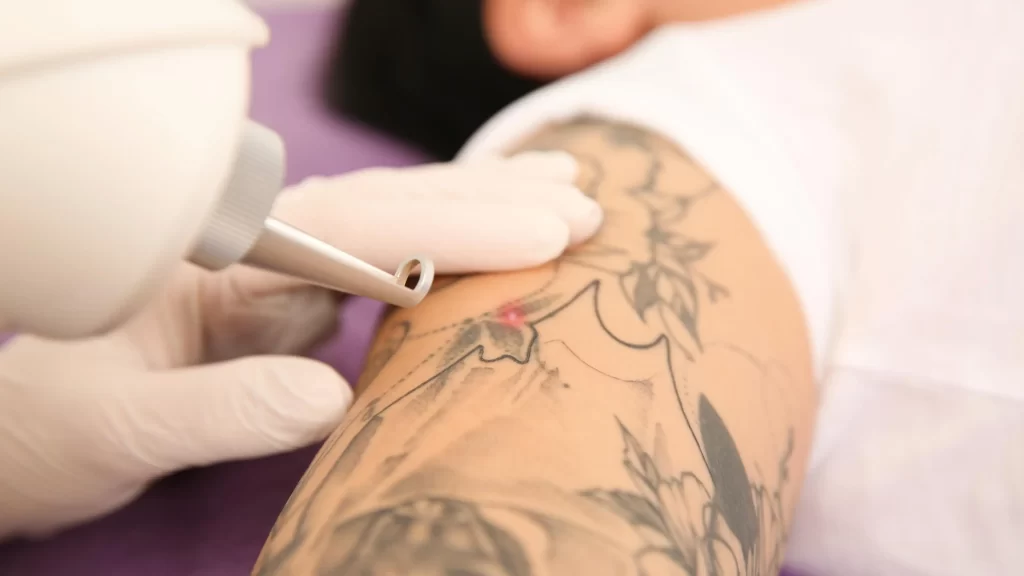

Tattoo removal may be considered because of changing personal preferences, professional concerns, an unwanted tattoo or an adverse reaction to tattoo pigment. Q-switched lasers are among the technologies used for selected tattoo colours, although they are not equally effective for every tattoo.
The return to daily activities is often relatively quick, but the treated skin still requires time to heal. The recovery period depends on the tattoo, treatment intensity, body area, skin tone and individual healing response.
What Is a Q-Switched Laser?
A Q-switched laser delivers very short pulses of high-energy light. The selected wavelength is absorbed by certain tattoo pigments, causing the ink particles to fragment into smaller pieces.
The body’s immune system may gradually clear some of these particles during the weeks following treatment.
The laser does not remove the entire tattoo immediately. Fading usually develops gradually and repeated sessions are often required.
Q-switched systems may use different wavelengths. Each wavelength interacts differently with particular pigment colours.
Dark inks such as black often respond more predictably because they absorb a broad range of wavelengths. Other colours may be more difficult to treat.
Green, blue, red, yellow, white, flesh-toned and fluorescent pigments may respond differently depending on their chemical composition and the available wavelength.
White, flesh-toned and certain cosmetic tattoo pigments may sometimes become darker after laser exposure. A test spot may therefore be considered before treating the entire area.
Does the Laser Damage the Skin?
Q-switched lasers are designed to direct energy toward tattoo pigment while limiting unnecessary injury to the surrounding tissue.
However, the skin still receives energy, and temporary tissue reactions are expected.
Possible reactions include:
-
Redness
-
Swelling
-
Tenderness
-
A whitening or frosted appearance immediately after treatment
-
Pinpoint bleeding
-
Blistering
-
Crusting
-
Itching
-
Temporary darkening or lightening of the skin
Less common complications include infection, persistent pigment changes, texture alterations and scarring.
It would therefore be inaccurate to state that the laser breaks up pigment without creating any skin damage.
Correct device selection, appropriate settings and professional aftercare reduce risk but cannot eliminate it completely.
How Is Q-Switched Laser Tattoo Removal Planned?
Before treatment, the tattoo and surrounding skin should be evaluated by a legally authorised and appropriately trained healthcare professional.
The assessment may include:
-
Tattoo colour
-
Type of pigment
-
Tattoo size
-
Pigment density
-
Professional or amateur application
-
Tattoo depth
-
Location on the body
-
Age of the tattoo
-
Previous removal attempts
-
Natural skin tone
-
Tendency to develop pigmentation
-
History of abnormal scarring
-
Current medication
-
Medical conditions
-
Recent sun exposure or tanning
Professional tattoos often contain more ink and may be placed at a more consistent depth than amateur tattoos. This can affect the number of sessions required.
Layered or cover-up tattoos may also respond differently because several pigments may be present at different depths.
What Happens During the Procedure?
The treatment area is cleaned, and protective eyewear is required.
Depending on the tattoo location and individual sensitivity, cooling, topical anaesthesia or another comfort measure may be considered.
The laser is applied in short pulses across the tattoo. Sensations are often described as snapping, stinging, heat or a rubber-band-like feeling.
The procedure should not be described as painless for everyone. Discomfort varies according to:
-
Tattoo location
-
Treatment intensity
-
Size of the area
-
Individual pain sensitivity
-
Cooling method
-
Previous treatment experience
The length of the appointment varies. A small tattoo may be treated quickly, while a large or multicoloured tattoo may take longer.
A standard duration of 15 to 30 minutes does not apply to every procedure.
How Many Sessions Are Required?
Tattoo removal generally requires several sessions, but the precise number cannot be guaranteed before treatment.
Important factors include:
-
Ink colour
-
Ink density
-
Tattoo depth
-
Tattoo size
-
Professional or amateur application
-
Presence of layered pigment
-
Skin tone
-
Body location
-
Immune response
-
Laser wavelength
-
Treatment settings
-
Healing between sessions
Some tattoos may fade significantly without disappearing completely. Others may leave a faint outline, residual colour or textural difference.
A standard course of six to ten sessions should not be promised to every individual. Some tattoos may require fewer treatments, while others may require considerably more.
Complete removal is not always possible.
How Long Should There Be Between Sessions?
The skin and immune system need time to respond after each procedure.
Intervals are often measured in weeks, but there is no single schedule that is suitable for every person.
The next session should not be performed simply because a fixed number of weeks has passed. The treated skin should have healed adequately.
Body location may also affect fading. Tattoos on areas with slower circulation may respond more gradually than tattoos closer to the centre of the body.
Performing sessions too frequently may increase the risk of irritation, pigment changes and scarring without necessarily improving clearance.
What Can Be Expected Immediately After Treatment?
Immediately after the procedure, the treated area may appear white or frosted. Redness, swelling, warmth and tenderness may then develop.
Small blisters or superficial crusting may occur. These reactions do not automatically indicate a complication, but the area should be monitored carefully.
The severity and duration of the reaction depend on the device, settings, tattoo characteristics and individual skin response.
Mild redness may settle within several days in some individuals. Blistering, crusting or pigment changes may take longer to resolve.
Increasing pain, spreading redness, pus, fever or an unpleasant odour may indicate infection and requires medical evaluation.
Returning to Daily Life
Many individuals can resume light daily activities after treatment.
However, the treated area should be protected from friction, contamination, intense heat and unnecessary trauma while it heals.
The ability to return to work or social activities depends partly on the location of the tattoo.
For example, swelling or a dressing on a visible area may temporarily affect comfort or appearance. A tattoo in a region exposed to clothing, footwear or repetitive movement may also require additional protection.
Activities that may need to be limited temporarily include:
-
Strenuous exercise
-
Swimming
-
Sauna and steam-room use
-
Very hot showers or baths
-
Contact sports
-
Activities causing heavy sweating
-
Prolonged sun exposure
-
Rubbing from tight clothing
-
Shaving over irritated skin
Restrictions should continue for the period recommended by the treating professional rather than for a universal number of days.
Exercise After Tattoo Removal
Strenuous exercise can increase circulation, heat, sweating and friction around the treated area.
These effects may increase swelling, discomfort or irritation during early recovery.
Light movement may be possible, but high-intensity exercise may need to be postponed until the skin is no longer blistered, open or significantly inflamed.
The treatment location should also be considered. Exercise involving repeated stretching or rubbing of the treated area may require a longer break.
Avoiding exercise does not make the laser remove pigment faster. The temporary restriction is intended to protect healing skin.
Swimming and Water Exposure
Swimming pools, hot tubs, lakes and the sea may expose recently treated skin to microorganisms, chemicals and prolonged moisture.
Swimming should generally be avoided until the skin surface has healed and there are no open areas, active blisters or crusts at risk of detachment.
The treated area may be cleaned according to the practitioner’s instructions, but prolonged soaking should be avoided during early healing.
Aftercare Following Q-Switched Laser Treatment
Follow the Wound-Care Instructions
Aftercare varies according to the skin reaction and the practitioner’s protocol.
The area may need to be kept clean and protected with a suitable dressing for a limited period.
Products should not be applied randomly to open, blistered or crusted skin.
A prescribed or recommended ointment should be used only as directed.
Do Not Pick Blisters or Crusts
Blisters should not be intentionally opened unless a healthcare professional provides specific instructions.
Crusts should be allowed to separate naturally.
Picking or scratching may increase the risk of infection, pigment changes and scarring.
Use Cold Compresses Carefully
A cool compress may reduce discomfort and swelling.
Ice should not be applied directly to the skin. It should be wrapped in a clean cloth and used for short periods according to professional advice.
Avoid Irritating Products
Until the skin has healed, the following may need to be avoided:
-
Exfoliating acids
-
Retinoids
-
Alcohol-based products
-
Fragranced products
-
Scrubs
-
Harsh cleansers
-
Depilatory products
Sun Protection
Sun protection is important before and after tattoo-removal treatment because ultraviolet exposure may increase the risk of pigment changes.
Recently treated skin should initially be protected with clothing or a clean covering when topical sunscreen is not appropriate.
Sunscreen should not be applied indiscriminately to open, blistered or actively weeping skin.
Once the surface has healed sufficiently, a broad-spectrum sunscreen may be used according to the practitioner’s instructions.
Additional protection may include:
-
Covering the area with clothing
-
Staying in the shade
-
Avoiding intentional tanning
-
Avoiding tanning beds
-
Reapplying sunscreen when appropriate
Sun protection may reduce additional pigmentation risk, but it does not guarantee scar-free healing or complete tattoo removal.
Should the Area Be Kept Moist?
The phrase “keep the area moist” can be misleading without a specific wound-care plan.
Some treated areas may benefit from a thin layer of a recommended ointment and a suitable dressing. Excessive moisture, occlusion or unapproved products may irritate the area or increase infection risk.
The correct approach depends on whether the skin is intact, blistered, crusted or open.
The treating professional’s instructions should therefore be followed precisely.
Pain and Discomfort Management
Temporary burning, stinging, tenderness or swelling may occur after treatment.
Comfort measures may include:
-
A carefully applied cool compress
-
Protecting the area from friction
-
Elevating the limb when appropriate
-
Using a pain reliever approved by the healthcare professional
Medication should not be selected solely from general online advice.
Prescription blood thinners or other medication should never be stopped without approval from the prescribing physician.
Pain that becomes more severe rather than gradually improving should be assessed.
Temporary Colour Changes
Temporary darkening or lightening of the surrounding skin may develop after laser treatment.
The risk may be higher in darker skin tones, recently tanned skin or when aggressive settings are used.
Some colour changes resolve gradually, but persistent hypopigmentation or hyperpigmentation can occur.
The tattoo pigment itself may also change colour. Cosmetic pigments containing iron or titanium compounds may darken after laser exposure.
This possibility should be discussed before treatment.
Is Scarring Possible?
Scarring is not inevitable, but it is a recognised risk.
The likelihood may increase because of:
-
Previous scarring within the tattoo
-
Excessive treatment intensity
-
Infection
-
Picking at crusts
-
Repeated trauma
-
Inadequate healing time
-
Keloid tendency
-
Unauthorised treatment
-
Poor aftercare
Some apparent texture changes may have existed before removal because tattooing itself can create scar tissue.
The practitioner should examine and document the area before treatment.
Who May Not Be Suitable for Immediate Treatment?
Treatment may need to be postponed or modified in the presence of:
-
Active skin infection
-
Open wounds
-
Recent sunburn or tanning
-
Uncontrolled eczema or dermatitis
-
Certain photosensitising medications
-
Abnormal scarring tendency
-
Pregnancy or breastfeeding, depending on clinical circumstances
-
Recent intensive treatment in the same area
-
An unexplained reaction within the tattoo
-
Unrealistic expectations
Allergies, medication use and previous reactions should be discussed during consultation.
Q-Switched Tattoo Removal at Ankara Laser
Ankara Laser or another qualified medical provider should evaluate the tattoo before treatment.
The consultation should explain:
-
Which laser wavelength will be used
-
Which colours are expected to respond
-
Which pigments may be resistant
-
The possibility of pigment darkening
-
Expected recovery
-
Possible side effects
-
Approximate treatment course
-
Alternative methods
-
Situations in which complete removal may not be possible
The decision should not be based solely on promotional claims that a device can remove every colour without damaging the skin.
Frequently Asked Questions
How Long Does One Session Take?
The duration depends on the tattoo’s size, colour, location and complexity.
A small tattoo may require only a brief laser application, while a larger or multicoloured tattoo may take longer.
How Many Sessions Are Needed?
There is no fixed number.
Some tattoos respond after several sessions, while dense, layered, colourful or resistant tattoos may require many treatments.
Complete clearance cannot be guaranteed.
Can a Scar Remain?
Scarring is possible, although it is not expected in every case.
Temporary redness, blistering, crusting and pigment changes are more common.
The risk depends on the tattoo, skin response, settings, healing process and aftercare.
Can I Return to Work the Same Day?
Many individuals can return to non-strenuous work.
However, pain, swelling, dressing requirements or the visibility and location of the treated area may affect comfort.
When Can Exercise Resume?
Exercise should be resumed according to the skin’s healing and the practitioner’s instructions.
Strenuous activity should generally be avoided while the area is open, blistered or significantly inflamed.
Can Make-Up Be Applied Over the Area?
Make-up should not be applied to open, blistered, crusted or irritated skin.
It may be restarted after adequate healing and professional approval, particularly when the tattoo is located on the face.
Are All Tattoo Colours Removable?
No.
Black and certain dark pigments often respond more predictably. Light colours, yellow, white, flesh-toned pigments and some greens or blues may be resistant or require specific wavelengths.
Some cosmetic pigments may darken.
Are the Results Permanent?
Pigment that has been successfully fragmented and cleared does not normally re-form.
However, residual ink may remain, and the tattoo may not disappear completely.
In conclusion, returning to daily life after Q-switched laser tattoo removal is often possible within a relatively short period, but the treated skin still requires careful protection. Exercise, swimming, heat exposure, friction and sun exposure may need to be limited temporarily. Recovery, session intervals and the degree of tattoo fading vary considerably, and complete removal without pigment change or scarring cannot be guaranteed.
 Call
Call
 Whatsapp