


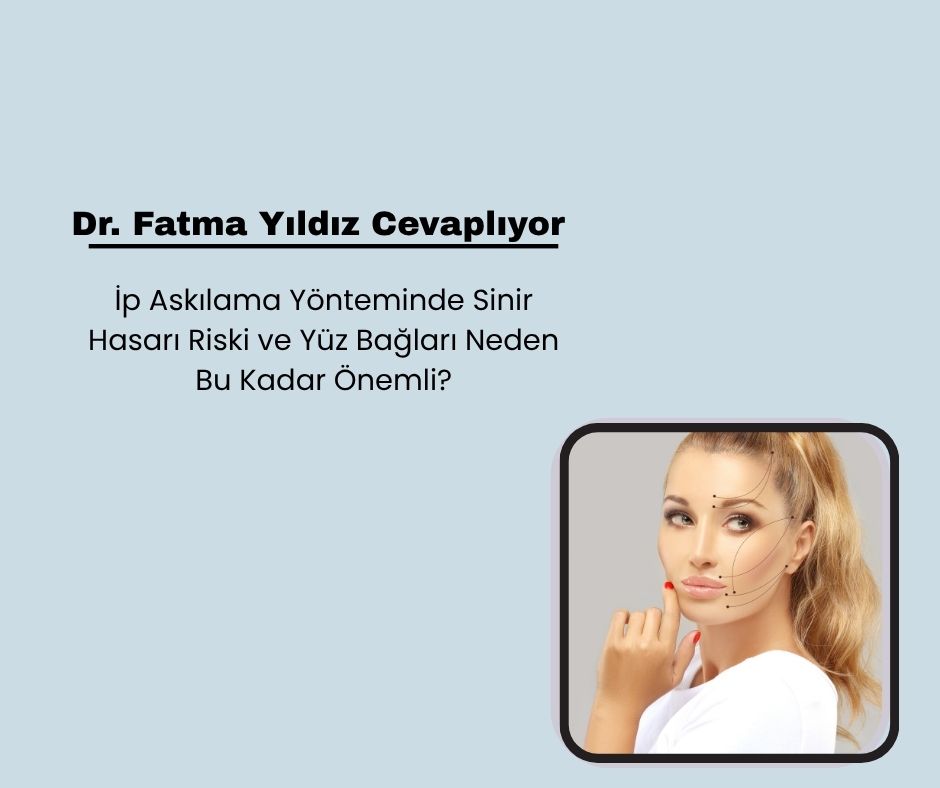

The Risk of Nerve Damage in Thread Lifts, and Why Are Facial Ligaments So Important?
Thread lifts, which are gaining popularity among non-surgical facial rejuvenation methods, are preferred due to their minimally invasive nature and rapid recovery. However, a proper understanding of facial anatomy, particularly the facial nerves and their attachment ligaments, is crucial for the success of this procedure. So, how can the risk of nerve damage be reduced with thread lifts, and why are the facial ligaments so important?
Facial Nerves: Avoid Damage for Beauty's Sake
The facial nerve (n. facialis) is a vital structure that governs the muscles of facial expression and enables the formation of expressions. This nerve has five main branches: temporal, zygomatic, buccal, marginal mandibular, and cervical. These branches control a wide range of areas, from the forehead muscles to the chin.
Care must be taken during thread lift procedures to avoid damaging these nerve branches. The procedure should generally be performed in the more superficial supraSMAS layer, rather than the subSMAS. This prevents direct contact with the nerves.
The temporal branch, in particular, is responsible for forehead and eyebrow movements. If care is not taken during suspension applications in the temple area, this branch can be damaged, resulting in weakness in the eyebrow lift. The Pitanguy line helps determine the course of this branch: it extends from 0.5 cm below the tragus to 1.5 cm lateral to the eyebrow. The cannula or needle should be advanced carefully, avoiding extending beyond this line.
While using blunt-tipped cannulas reduces this risk, the precision required during the procedure is the primary determining factor.
What Causes Pain During Mouth Movement?
One of the most frequently reported discomforts after thread suspension is pain during mouth movements. This is usually not due to direct nerve damage, but rather to the placement of the threads in the perioral muscles (around the mouth).
The area around the mouth is a highly mobile area. Because the threads placed here attach to the tissues that move during speaking, smiling, or chewing, a pulling sensation or pain may occur during these movements. This condition is usually temporary and gradually disappears within a few weeks. However, patients should be informed about this beforehand, especially after procedures using thick threaded sutures.
Facial Retaining Ligaments: The True Anchor of the Lift
In facial aesthetics, not only the subcutaneous tissues but also the ligaments that hold these tissues in place are of great importance. Retaining ligaments are divided into two main groups:
True retaining ligaments: These ligaments originate from the bone and extend to the skin. Examples include the orbital, zygomatic, maxillary, and mandibular ligaments.
Pseudo-ligaments: They originate from soft tissues such as muscle or fat.
These ligaments maintain facial expressions and also prevent sagging. The zygomatic and masseteric cutaneous ligaments, in particular, are vital for the attachment of the sutures in midface lifts.
These sutures create the most effective lifting effect when fixed to these ligaments. A successful lifting effect can be achieved solely through these natural connective tissues, without the need for additional fixation.
Risks of Over-Fixation: Permanent Scarring and Collapse
Attaching the threads too tightly to the ligaments can reverse the aesthetic outcome. Complications such as skin collapse, irregularities, or permanent scarring can occur, especially if excessive tension is applied to the tissue at the fixation point.
Therefore, during thread placement, both the location of the ligaments and the depth and tension of the thread must be meticulously adjusted. A well-trained and experienced physician can achieve natural and lasting results by achieving this delicate balance.
Conclusion: Success in Aesthetics Depends on Anatomy
Thread suspension is a highly effective and safe procedure when performed by the right hands and with due respect for facial anatomy. Careful evaluation of the nerves and ligaments both reduces the risk of complications and enhances aesthetic effectiveness. Therefore, detailed pre-procedure planning, proper technique, and patient information are essential.
 Call
Call
 Whatsapp