


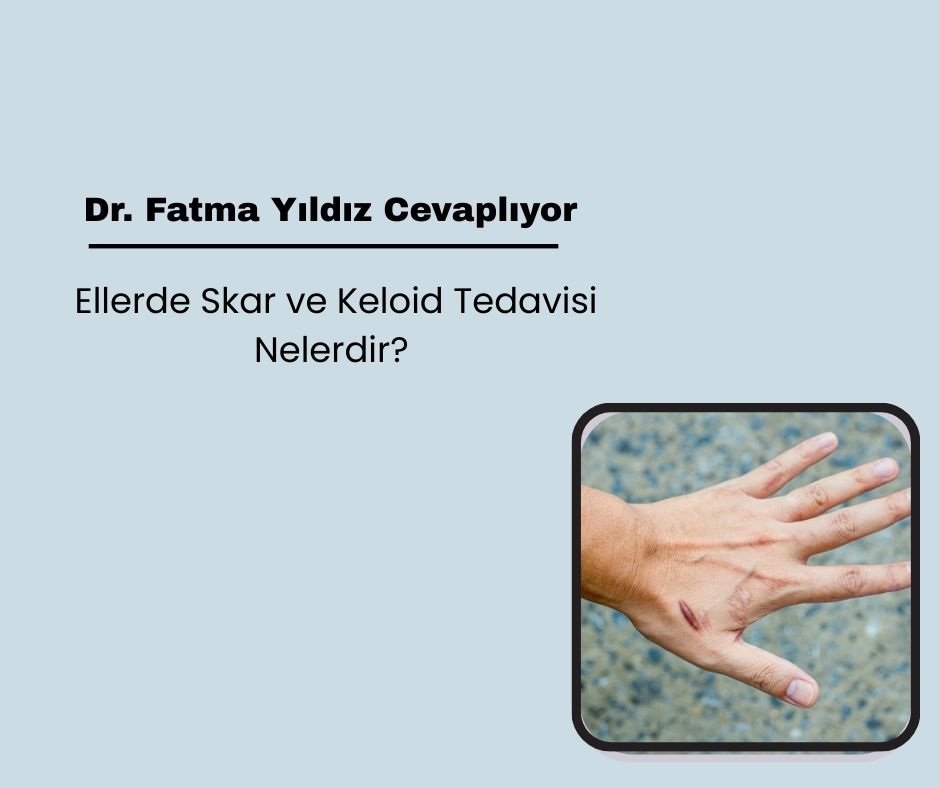

What are Scar and Keloid Treatments on Hands?
Our hands are one of the most striking areas in terms of both aesthetics and functionality, being in constant contact with the environment throughout the day. Therefore, scars (scars) or obvious skin disorders such as keloids that form on the hands can negatively affect not only the visual aspect but also the social life and psychological state of the person.
What are Scars and Keloids?
After an injury to the skin, the body produces collagen to ensure the healing of the wound. Under normal conditions, this process results in a flat and thin scar tissue. However, in some individuals, the healing process goes too far. In this case, a keloid, which is a structure that extends beyond the wound borders, is raised, hard and usually itchy from the skin level, may form.
Scars are more common and can appear in various forms:
Atrophic scar: Traces in the form of depressions as a result of tissue loss under the skin.
Hypertrophic scar: Raised and hard scars that remain within the wound borders.
Pigmented scar: Characterized by color change.
Why Especially Hands?
Scar and keloid treatment on the hands should be done more carefully compared to other parts of the body. Because the hands are constantly in motion, exposed to environmental factors and the skin structure is thinner. In addition, the wound healing process can be negatively affected by friction and microtraumas in the area.
Treatment Methods
The treatment process is planned by considering the type, depth, color of the scar, the patient's skin type and expectations. The most commonly used methods in the treatment of scars and keloids on the hands are as follows:
1. Fractional Lasers
Fractional CO2 and Er:YAG lasers provide controlled regeneration in the skin by creating microthermal damage. With this method, the surface of the scar can be smoothed, color inequalities can be reduced and skin quality can be improved. Dose adjustment should be made carefully in thin-skinned areas such as the hands.
2. Fractional Radiofrequency
Needle fractional radiofrequency systems reach the dermis, increase collagen production and help soften the scar. With the effect of heat, tightening and regeneration occur in the internal structure of the skin. Its use on the hands provides advantages, especially in individuals with a tendency to keloids.
3. Mesotherapy
Contents that support skin renewal, such as hyaluronic acid, amino acids, vitamins, and peptides, are applied to the scarred area using the microinjection method. More effective results can be obtained when this method is combined with laser or radiofrequency applications.
4. Steroid Injections
Intralesional corticosteroid injections, especially used in keloid treatment, can prevent excessive tissue growth. It is usually applied in several sessions. In some cases, it is combined with supportive agents such as local anesthetics or 5-FU.
5. PRP (Platelet Rich Plasma) and Stem Cell Applications
Platelet-rich plasma obtained from the patient's own blood supports skin renewal, allowing the scar to heal faster and healthier. Stem cell applications are preferred to increase collagen production, especially in stubborn and deep scars.
Why is a Combined Approach Important?
A treatment method applied alone is usually not sufficient. Especially in areas that are difficult to heal and mobile, such as the hand, more effective and permanent results can be obtained with combined protocols. For example, applying PRP or mesotherapy after laser accelerates skin healing and increases effectiveness.
Personal Planning
Each individual's skin structure and healing potential are different. Therefore, treatment planning should be made by taking into account the type of scar, its duration, the person's skin type, age, accompanying health problems and the time they can allocate to treatment.
Treatment Process and Follow-up
The treatment process may cover several sessions. After each session, slight redness and crusting may be seen on the skin. Using sunscreen after treatment, moisturizing the skin and regular use of recommended support products are of great importance for the success of the treatment.
Conclusion
Treatment of scars and keloids formed on the hand is a process that requires patience and regular follow-up. With current technologies, it is now possible to reduce the appearance of these scars and improve skin quality. With the correct evaluation to be made by a specialist physician and a personalized treatment plan, aesthetic and functionally satisfactory results can be achieved.
 Call
Call
 Whatsapp