


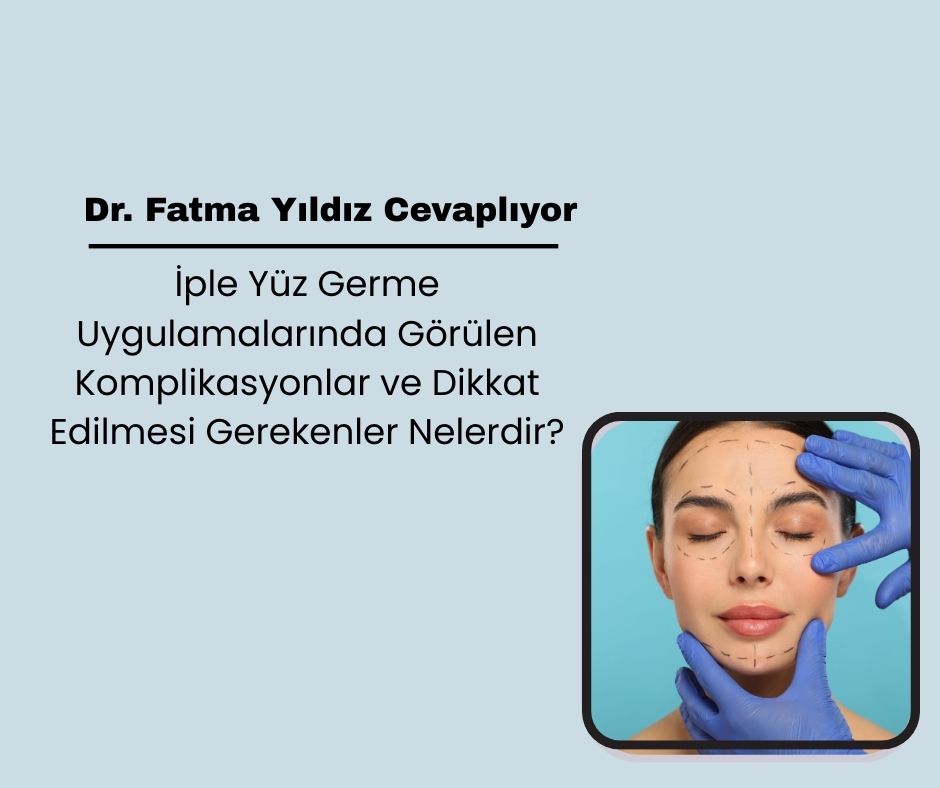

What are the Complications in Thread Face Lift Procedures?
Thread facelift is a technique that has become increasingly popular in recent years among minimally invasive aesthetic procedures. Using special threads made of materials such as polypropylene or polydioxanone (PDO), sagging areas of the face are lifted upwards and a rejuvenation effect is achieved. However, these procedures also have their own complications and risks.
What is Thread Facelift?
First developed in the 1970s and popularized with Aptos and Contour threads after the 1990s, the thread facelift technique creates a lifting effect on the skin with the help of notched threads placed under the skin. This method, which is less traumatic than surgery, is completed in a short time with local anesthesia and the recovery period is quite short.
Appropriate Patient Selection and Contraindications
Patient selection is of critical importance in minimizing the risk of complications. Thread applications are contraindicated in the following cases:
Serious systemic diseases, connective tissue diseases
Active infections, autoimmune diseases
Pregnancy, breastfeeding, anticoagulant use
History of keloids or hypertrophic scars
Relative contraindications include factors such as smoking, eczema/psoriasis, very thin or thick skin structure.
Post-Application Recommendations
To reduce complications after the procedure, patients should be advised as follows:
In the first week, the patient should lie on his/her back and the face should not be exposed to pressure.
Mimicry and chewing movements that will strain the muscles around the mouth should be avoided.
Antibiotics should be used for 5 days, and acetaminophen should be preferred in case of pain.
Frequently Seen Complications
Dimples at the entry site: Common in superficial applications.
Visibility of the thread: May occur in threads that are not placed deep enough.
Thread migration or breakage: May occur over time with muscle activity.
Early return: May occur due to technical inadequacy, incorrect patient selection and poor tissue integration.
Infection, edema, asymmetry and skin irregularities
Ways to Reduce the Risk of Complications
Using threads of the correct thickness and length
Placing the thread in the subcutaneous plane, deep enough
Increasing the adhesion with curved or zig-zag applications
Selection of ideal application areas (areas with low muscle activity)
Combined applications with botulinum toxin (reducing muscle strength)
Importance of Material Selection
PDO threads are preferred due to their long-term effect and low complication rates. The risk of bacterial colonization is low thanks to their monofilament structure. However, the risk of late-term reactions and irregularities is higher in non-absorbable threads.
Conclusion
Thread facelift offers an effective anti-aging solution when applied with appropriate patient selection and correct technique. However, this method does not replace a surgical facelift; expectations should be managed correctly. The risk of complications can be minimized with applications supported by trained specialists and knowledge of anatomy.
 Call
Call
 Whatsapp