



What are the Complications of Thread Face Lift?
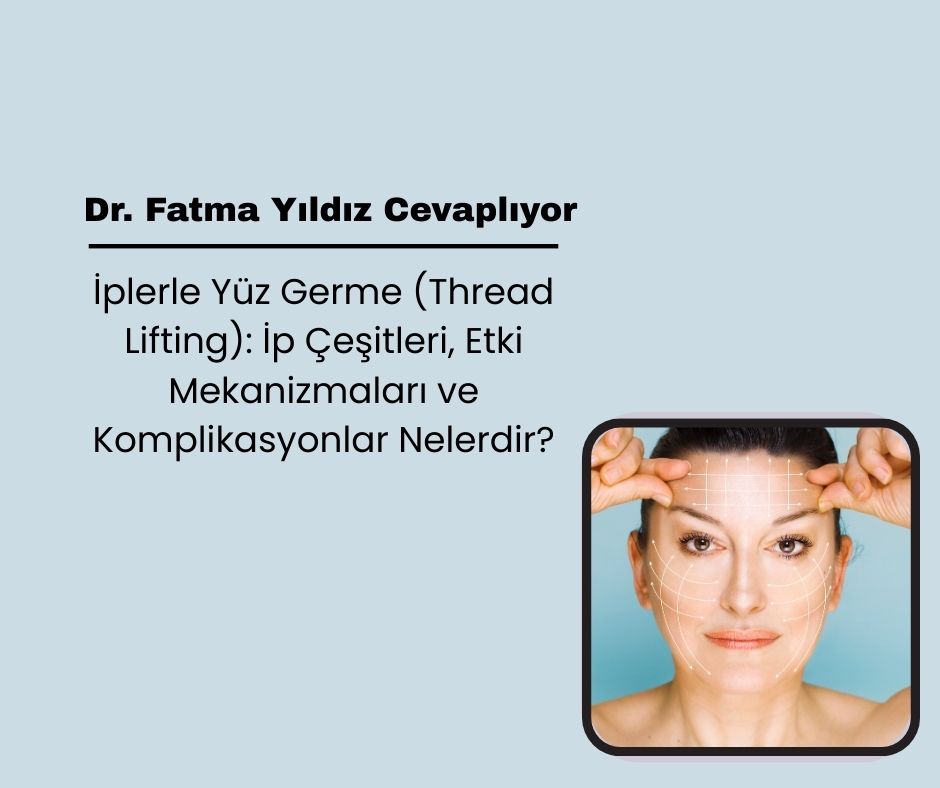
Wrinkles, sagging, volume loss and tone deterioration that occur on the skin over time; bring with them the desire for a young, vigorous and aesthetic appearance. Thread lift, developed as an alternative to surgery, is quite popular today because it is a minimally invasive technique.
What is the Basic Mechanism of the Thread Lift Method?
The effect of threads on the face is not just a physical lift. Threads placed under the skin; trigger collagen production, increase circulation, facilitate the elimination of toxins and improve overall skin quality.
Mechanisms of Action:
Provides mechanical lifting and tissue support.
Increases collagen and elastin production.
Improves skin tone, elasticity and volume.
Reduces edema by increasing lymph drainage and triggers lipolysis.
Supports skin renewal by stimulating the immune system.
Indications for Facial Thread Application
Eyebrow and forehead lift
Cheek, jawline and neck tightening
Reduction of nasolabial and marionette lines
Correction of lip line
Asymmetry correction
Reduction of facial fat accumulation
Types of Threads Used
There are three main types of threads that are FDA approved and widely used in the market:
PDO (Polydioxanone) Threads: These are the most commonly used, bioabsorbable threads. They can be in various structures and forms.
PLLA (Poly-L-Lactic Acid) Threads: Stimulate collagen production for a long time.
PCL (Polycaprolactone) Threads: Provides longer-term permanence.
Main Types of PDO Threads
Mono Threads: Flat, simple structure; used for tightening and biostimulation.
Twin Mono Threads: There are two threads in one needle; their effectiveness is high.
Twisted Threads: It is wrapped in a spiral shape; the lifting effect is greater.
Thread Application Area: SMAS Layer
The threads are placed in the structure called "SMAS" (Superficial Musculoaponeurotic System) in the facial anatomy. This area is a fibrous layer that connects the muscle and fat tissues under the skin. Placing the threads here ensures that the lifting effect is natural and permanent.
Contraindications: Who is it not applied to?
Those with collagen tissue disease
People with a weak immune system
Those taking blood thinners
People prone to keloid formation
Pregnant and breastfeeding women
Those with an active infection or herpes history
Possible Side Effects and Complications
Temporary side effects:
Redness, edema
Tenderness, pain
Superficial bruising
Temporary asymmetry
Complications:
Infection
Displacement, dislocation or breakage of the thread
Foreign body reaction
Vascular-nerve damage
Neuropathic pain
Pseudolymphoma or cyst formation
Conclusion
Thread suspension applications are one of the ideal solutions for individuals who want to rejuvenate without the need for surgery. The application requires technical knowledge and experience. With the right indication and appropriate patient selection, quite satisfactory results can be obtained.
 Call
Call
 Whatsapp