


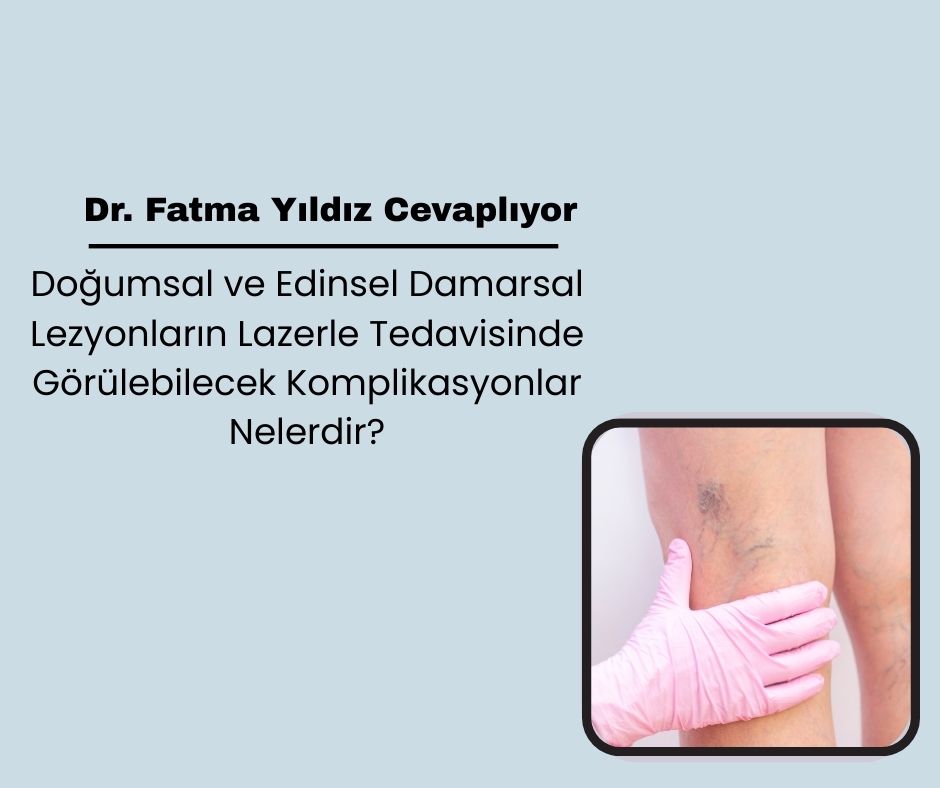

What are the Complications That Can Be Seen in Laser Treatment of Congenital and Acquired Vascular Lesions?
Laser systems have been widely used in the treatment of congenital and acquired vascular lesions in recent years and have come to the forefront as an effective non-surgical treatment method for many clinical conditions. This treatment approach, based on the principle of selective photothermolysis, causes damage to the target tissue while providing minimal effects on surrounding tissues. The target chromophore in laser treatment is usually hemoglobin and different wavelengths are effective in vascular structures at different depths. Pulsed dye laser (PDL), KTP, Nd:YAG, alexandrite and diode laser systems are frequently used for this purpose.
Basic Elements that Reduce the Risk of Complications in Laser Vascular Lesion Treatment
Detailed evaluation and information of patients before starting treatment are the most important steps in reducing the risk of complications. In individuals planned to receive laser treatment:
Skin type (according to Fitzpatrick scale),
Lesion type (e.g. hemangioma, port wine stain, telangiectasia),
Location of the lesion,
Previous treatments,
Factors such as the presence of systemic disease should be carefully analyzed.
During the patient information phase, the treatment process, number of sessions, success expectation, recovery period and possible side effects should be explained in detail and written consent should be obtained. As a result of the evaluation made by an experienced physician, complications can be largely prevented with the correct device selection, use of appropriate parameters and post-treatment care recommendations.
Complications That May Develop Due to Laser Application
Although laser treatments are generally considered safe, temporary or permanent complications may be observed in some cases. These complications are divided into two as acute and chronic:
1. Erythema
Transient erythema (redness) is observed in almost all patients following laser application. This condition occurs due to epidermal melanin absorption and local vasodilation. It regresses within hours when appropriate cooling techniques are used, but it can last up to a few days in some individuals.
2. Hyperpigmentation
It is more common in individuals with dark skin. It occurs when epidermal melanocytes increase melanin production in response to heat after laser application. It is usually temporary and can resolve spontaneously within a few weeks. The process can be accelerated with the use of sunscreen and topical lightening agents.
3. Hypopigmentation
Hypopigmentation that develops as a result of melanocyte damage can be permanent. It usually occurs in individuals with light skin after high energy use or repeated sessions. The risk of this complication can be minimized with careful selection of laser parameters and appropriate cooling.
4. Purpura and Ecchymosis
It is common in laser systems with short pulse durations such as PDL. It occurs as a result of extravasation after coagulation of vascular structures. It usually resolves spontaneously within 5-14 days. Patients should be informed in advance that this condition is an expected and temporary side effect.
5. Crusting and Flaking
Superficial crusting and desquamation may be observed in cases accompanied by epidermal damage. In this case, patients are advised not to pick the crusts and to use moisturizers. Recovery without sequelae is expected, but if appropriate care is not provided, infection may develop.
6. Acneiform Rashes
Temporary acne-like lesions may be seen, especially in areas exposed to intense heat. These rashes usually disappear on their own within a few days and do not require treatment.
7. Infection
Bacterial or viral infections may develop due to damage to the epidermal barrier after laser. Prophylactic antiviral treatment should be considered, especially in individuals with a history of herpes simplex. It is recommended that local antibiotics and antiseptic cleaning not be neglected.
8. Scarring and Tissue Atrophy
Although rarely seen, thermal damage resulting from inappropriate parameter use may cause permanent scarring. The risk increases especially in applications performed with high energy and in cases where sufficient epidermal cooling is not provided.
9. Paradoxical Telangiectasia
It is characterized by the formation of new vascular structures around or near the treated area. The cause is thought to be an increase in vascular growth factors. Additional treatment may be required.
Strategies to Prevent Complications
Correct Laser and Wavelength Selection: Each type of vascular lesion consists of vessels of different depths and diameters. KTP or PDL should be preferred for superficial lesions; Nd:YAG laser should be preferred for deep and large vessels.
Appropriate Parameter Setting: Energy density, pulse duration and spot diameter should be selected according to the targeted vessel depth and diameter.
Use of Cooling Systems: Provides pain control by reducing epidermal damage and reduces the risk of complications. Systems such as contact cooling, air cooling and cryogen spraying can be used.
Suitability for Skin Type: The risk of complications increases as the Fitzpatrick skin type increases. It is lower in dark-skinned individuals.
 Call
Call
 Whatsapp