


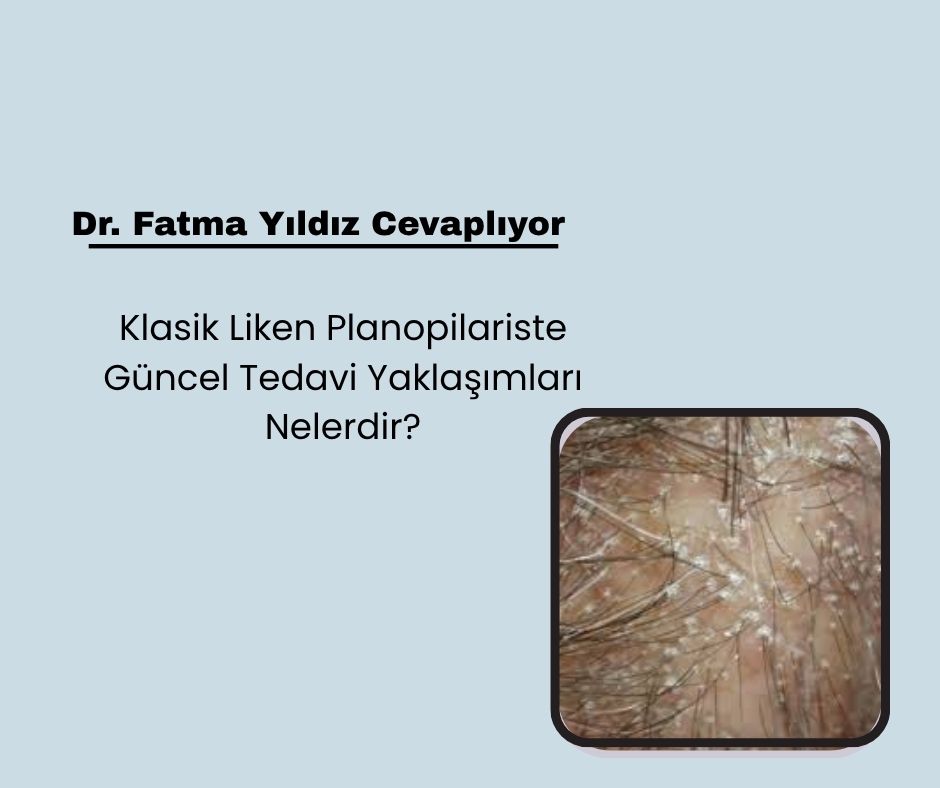

What are the Current Treatment Approaches for Classical Lichen Planopilaris?
Classical Lichen Planopilaris (LPP) is a rare but serious disease affecting the scalp. This autoimmune disease is characterized by inflammatory damage to the hair follicles and causes permanent hair loss due to scar tissue. Current treatment protocols focus on stopping the progression of the disease and relieving symptoms. In this article, we will discuss current treatment approaches for LPP based on scientific foundations.
Clinical Features and Diagnosis of Lichen Planopilaris
LPP is a chronic dermatosis characterized by itching, burning, hair loss and hyperkeratotic plaques on the scalp, usually seen in middle-aged women. In clinical examination, active inflammation and atrophy findings on the scalp are prominent. Diagnosis is usually made by scalp biopsy supported by clinical appearance.
Current Treatment Options
1. Topical and Intralesional Corticosteroids
In first-line treatment, high-potency topical corticosteroids and intralesional triamcinolone acetonide injections are generally preferred. These drugs can slow the progression of active disease by suppressing inflammation. However, the risk of skin atrophy should be considered in long-term use.
2. Systemic Treatments
Systemic agents are used to control inflammation and stop progression. These include drugs such as hydroxychloroquine, doxycycline, methotrexate, miconazole and cyclosporine.
Hydroxychloroquine is particularly effective in suppressing inflammation and is well tolerated in terms of side effects.
Doxycycline is preferred due to its anti-inflammatory effects and may be beneficial in the active phase of the disease.
Methotrexate is preferred in low doses in severe cases and is administered with a weekly regimen.
3. JAK Inhibitors
In recent years, the role of JAK inhibitors in the treatment of LPP has been investigated. Janus kinase (JAK) inhibitors have shown promising results, especially in treatment-resistant cases. Some small-scale studies with oral tofacitinib have shown a significant decrease in disease activity. However, the long-term safety of these agents is not yet clear.
4. Phototherapy and PRP
Low-level laser therapy (LLLT) and PRP (platelet rich plasma) injections can be used as complementary treatments. PRP, in particular, can support cell renewal by increasing microcirculation in the scalp.
Points to Consider in the Approach to Treatment
The main goal of treatment is to stop the progression of the disease and suppress inflammation.
Treatment should be personalized according to the patient's clinical severity, age, concomitant diseases and previous treatment response.
Early intervention before scarring occurs is important.
Conclusion
Classic Lichen Planopilaris is a chronic disease that is challenging to treat. Today, thanks to therapeutic agents that act through different mechanisms, the progression of the disease can be controlled and the quality of life can be improved. Especially early diagnosis, multidisciplinary approach and personalized treatment planning are the keys to successful results. In addition to classical treatments in the management of LPP, new generation targeted therapies are expected to find wider use in the coming years.
 Call
Call
 Whatsapp