


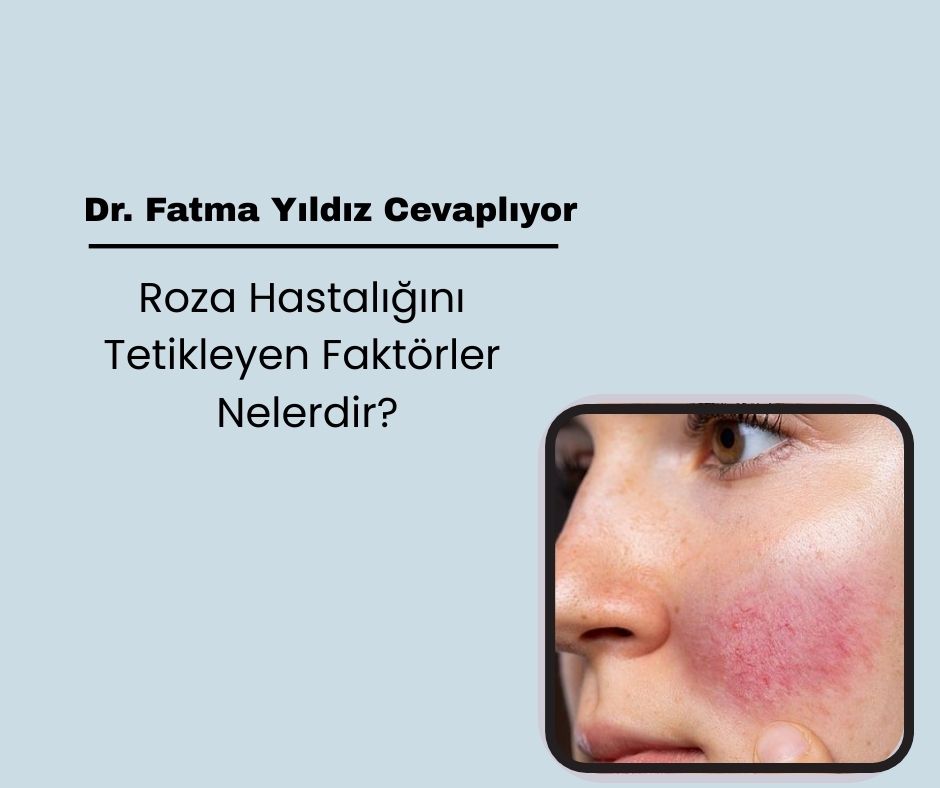

What are the factors that trigger rosacea?
Sun, Microorganisms, Heat and Stress
Rosa disease (rosacea) is a chronic skin disease that manifests itself with permanent redness, acne-like blisters and vascular dilatation on the face. Although it is not known exactly why the disease occurs, it has been determined that some environmental and biological factors exacerbate rosacea, that is, worsen it. Now let's examine these triggering factors one by one.
Sun Rays (Ultraviolet Exposure)
Lesions on the face of rosacea patients mostly occur in areas exposed to the sun. The absence of lesions in areas not exposed to the sun indicates that sunlight is effective in the disease. The symptoms become more pronounced especially in people with fair skin and in the spring months.
The damage caused by sun rays (especially UVA and UVB) to the skin occurs in several ways:
UVA rays disrupt collagen, the skin's supporting tissue. This causes the skin to lose its elasticity and increase redness.
UVB rays trigger blood vessel growth and cause vascular networks to form in the skin.
Sunlight also increases harmful molecules called reactive oxygen species (ROS) in the skin. These substances damage cells and increase inflammation. ROS levels are much higher in people with rosacea than in healthy individuals.
UV rays also cause overproduction of a protein called catalyzidin, which is part of the skin’s natural defense system. This protein increases the skin’s inflammatory response and contributes to the worsening of rosacea.
Recent studies have shown that UV rays affect certain immune system pathways (such as the TLR-MyD88 pathway) to trigger facial flushing and vascular dilation.
Skin Microorganisms
Normal bacteria and mites on the skin of people with rosacea may also contribute to the progression of the disease.
Demodex Mites
Tiny mites called Demodex folliculorum and Demodex brevis can be found even on healthy human skin. However, the number of these mites on the skin of rosacea patients is much higher.
Demodex mites live in the upper layer of the skin and trigger certain immune pathways, causing inflammation in the skin. In particular, the substances secreted by these mites lead to an increase in molecules related to inflammation such as IL-8, IL-1β and TNF-α in skin cells.
The bacteria released by dead mites also activate the body's defenses, causing more inflammation. This worsens rosacea symptoms.
Bacillus oleronius
A bacterium called Bacillus oleronius, which lives on Demodex mites, is also an important trigger. Studies have found that some proteins produced by this bacterium excessively activate the immune cells of rosacea patients. As a result of this activation, inflammation-increasing substances such as IL-6, IL-8, TNF-α, MMP-3 and MMP-9 are produced.
Helicobacter pylori
Helicobacter pylori, known as stomach bacteria, is more common in patients with rosacea.
It is thought that this bacterium may trigger rosacea because:
The rate of co-occurrence of diseases such as rosacea and stomach ulcers is high.
Rosacea symptoms and stomach diseases flare up at similar times during the year.
Antibiotic treatments for stomach bacteria have been shown to relieve both stomach and rosacea complaints.
However, the relationship between Helicobacter pylori and rosacea has not been definitively proven.
Other Microorganisms
There are studies indicating that some other bacteria such as Staphylococcus epidermidis and Chlamydia pneumonia may also be effective in the development of rosacea.
Temperature and Heat Exposure
In individuals with rosacea, an increase in temperature accelerates blood flow in the skin. Laser imaging studies have shown that there is dilation in the skin vessels and an increase in blood flow due to the effect of heat.
This effect occurs in two ways:
Fast-response vasodilation (via axon reflex)
Slow-response vasodilation (via nitric oxide)
In addition, heat activates ion channels called TRPV1 and TRPA1 in the skin. The constant activity of these channels exacerbates the redness, vasodilation and inflammation in rosacea.
Studies have shown that in patients with rosacea, the TRPV1 and TRPV2 genes are activated more than normal. This means hypersensitivity to temperature changes.
Stress
Stress is one of the important factors that trigger rosacea.
In stressful situations:
The sympathetic nerves in the skin become more active.
Intermittent dilations occur in the skin vessels.
This increases symptoms such as facial flushing and hot flashes.
The body’s main stress hormone, corticotropin-releasing hormone (CRH), increases production of substances such as IL-6, IL-8, and IL-18, which cause inflammation in the skin.
CRH also activates mast cells. These cells release histamine and nitric oxide, which dilate blood vessels and worsen redness.
CRH has also been found to have a direct dilating effect on blood vessels.
Spicy Foods, Alcohol and Medications
Spicy foods, alcohol and hot drinks can trigger flushing attacks in people with rosacea by stimulating the TRPV1 and TRPA1 channels. However, there is no definitive evidence that diet is the primary cause of rosacea.
Certain medications can also worsen the condition. In particular:
Amiodarone (a heart medication)
Steroids, either topical or in nasal sprays
High doses of vitamins B6 and B12
can trigger rosacea flare-ups.
Sunlight, skin microorganisms, heat, stress and certain foods and medications can trigger rosacea.
Avoiding these factors as much as possible can help keep the condition under control.
It is recommended that people with rosacea use sunscreen, manage stress and avoid trigger foods.
 Call
Call
 Whatsapp