


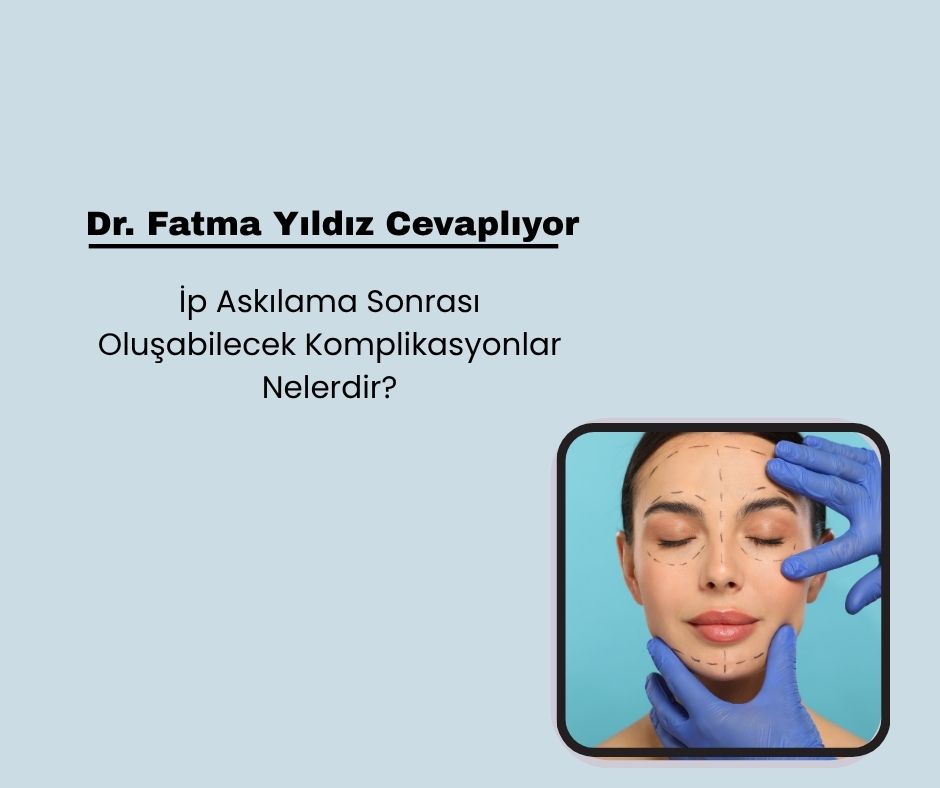

What Are the Possible Complications After Thread Lift?
With age, facial sagging, wrinkles, and volume loss become more noticeable. This has increased interest in non-surgical rejuvenation methods. Thread lifts, in particular, are frequently preferred for improving facial contours, lifting the skin, and achieving a more youthful appearance. However, like any aesthetic procedure, thread lifts carry some risks. In this article, we detail the complications that can occur after thread lifts, their causes, and how to manage them.
What Causes Dimples?
One of the most common complications after thread lifts is **dimples**. These dimples are usually caused by placing the threads too superficially under the skin or by the structural properties of the subcutaneous fatty tissue. Securing the threads too close to the skin or applying too much tension during thread placement can also cause this condition.
In some cases, dimples may appear immediately after the procedure, but in other cases, they may appear a few days later. In mild cases, improvement can be achieved with simple methods such as manual massage, molding, or saline injections. However, for more permanent dimples, treatments such as filler injections or thread removal may be necessary.
How Do Bulging and Contour Irregularities Develop?
Over-pulling or incorrectly positioning the thread can cause asymmetrical bulging or contour irregularities, especially in the cheeks and cheekbones. Long threads directed toward the temples can also protrude beyond the tissue and create an unaesthetic appearance.
In such cases, the first step is to attempt to soften the lump with massage. However, if the lump persists, the threads may need to be cut or removed. In some cases, especially for bulges in the temporalis region, botulinum toxin injections into the temporalis muscle can also improve the appearance of the surface.
What is Thread Migration and How Can It Be Prevented?
Thread migration refers to the threads becoming unstable and shifting over time. Particularly in active facial areas, if the threads are not properly secured, they can slip into undesirable areas. For example, threads can slip towards the eyelid after a brow lift, or threads that are not secured in the jowl area can migrate towards the throat.
The most effective way to prevent this is to secure the threads in appropriate anatomical locations. Botulinum toxin supplementation can also be used to maintain the threads' position in areas with movable muscles.
When Do Thread Protrusion and Skin Penetration Occur?
Sometimes, threads can protrude when they should remain under the skin. This can be caused either by placing the thread too close to the surface during the procedure or by migration due to body movements and skin structure.
Thread protrusion can also occur only during certain facial expressions. In such cases, the thread can be removed by making a small needle puncture. However, threads that are clearly visible and constantly protrude from the skin surface should usually be removed or trimmed.
How Can Permanent Problems Be Prevented?
Thorough patient evaluation before the procedure: Skin thickness, fat tissue density, and age must be considered.
Correct technique and appropriate depth: Inserting threads too superficially or too deeply carries risks.
Proactive patient communication: Potential complications must be explained to the patient before the procedure.
Follow-up and follow-up: A follow-up examination should be performed within 1-2 days after the procedure, and areas at risk of complications should be observed.
Conclusion: A Conscious Approach is Essential for Aesthetic Excellence
Thread lift procedures provide effective results when performed with careful technique in suitable patients. However, it is not possible to completely eliminate complications. Therefore, aesthetic procedures should be performed by specialists who can not only perform the procedure but also anticipate potential risks and intervene when necessary.
For solutions that erase scars, not leave scars...
At Ankara Life, we are here to help you with safe, scientific, and personalized aesthetic procedures.
 Call
Call
 Whatsapp