


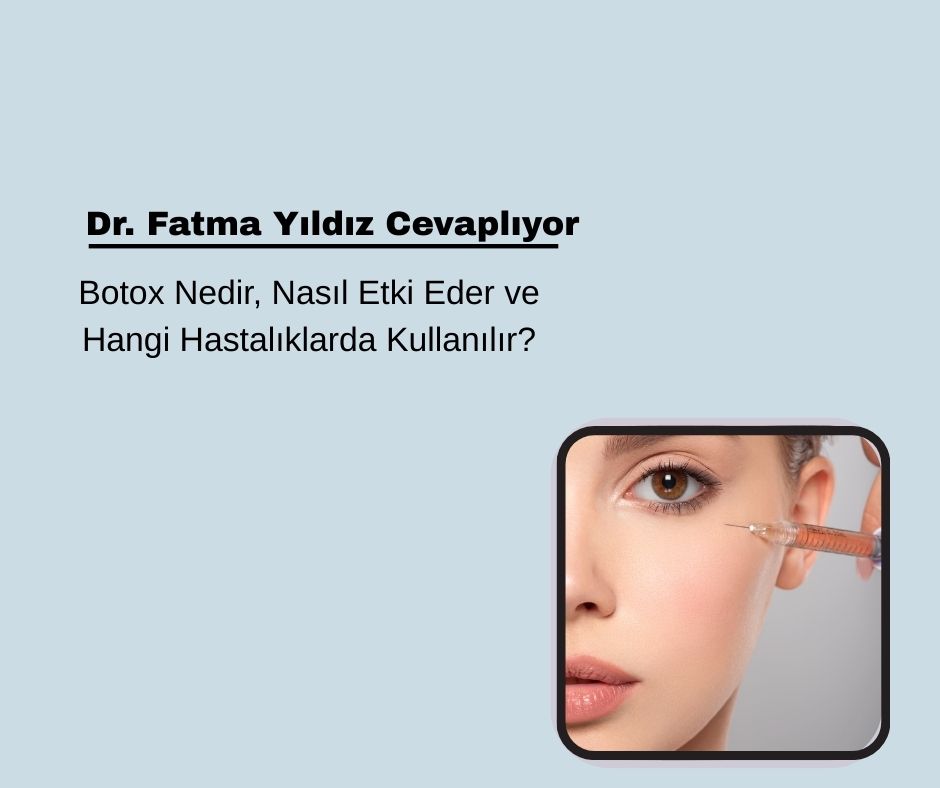

What is Botox, How Does It Work, and What Ailments Is It Used For?
Botulinum toxin, commonly known as Botox, is one of the most commonly used treatments in medicine and aesthetics. When most people think of Botox, they think only of wrinkle reduction. However, botulinum neurotoxins (BoNTs) currently demonstrate clinical efficacy in a much broader range of areas. In fact, Botox's journey has progressed with the discovery of new applications and is expected to continue in the future.
In this article, I will explain what Botox is, how it works, and its current therapeutic areas in a way everyone can easily understand. We will also discuss how Botox could be further developed in the future based on scientific advancements.
What is Botox?
Botox is a therapeutic drug derived from specific forms of a neurotoxin produced by the bacterium Clostridium botulinum. This toxin temporarily blocks neurotransmitter release at nerve endings, stopping muscle contraction. This eliminates unwanted muscle movements, spasms, and wrinkles.
In fact, tetanus toxin (TeNT), another toxin from the same family, also affects the nervous system. However, while tetanus causes sharp contractions, botulinum toxin causes muscle relaxation. This property makes Botox unique from a therapeutic and aesthetic perspective.
In Which Areas Is Botox Used?
1. Aesthetics and Dermatology
The most common area of use is for aesthetic purposes. Botox applications are commonly used in areas such as:
Forehead lines
Frown lines between the eyebrows
Crow's feet
Neck bands
The effects typically last 4-6 months.
2. Neurological and Muscular Disorders
Botox is used not only for beauty but also for the treatment of serious medical conditions. For example:
Spasticity (muscle contractions after a stroke)
Cervical dystonia (involuntary contraction of the neck muscles)
Eye muscle disorders (strabismus, blepharospasm)
Chronic migraine treatment
3. New Uses
In recent years, Botox has also been found effective in the following diseases and conditions:
Urological problems (overactive bladder)
Painful keloids and scars
Diabetic neuropathic pain
Refractory knee pain
Trigeminal neuralgia (severe nerve pain in the face)
Scar treatment after cleft lip surgery
Support for cancer treatment
Research on depression
As can be seen, Botox is no longer just an aesthetic procedure; it has begun to be used in a wide range of treatments.
How Does Botox Work?
Botox's effects occur at the nerve endings. Nerve cells send signals to the muscles via a chemical called acetylcholine. Botox blocks this signal and stops the muscle from contracting. This effect is reversible, meaning the nerve endings form new connections over time, and the muscles begin to move again.
The Botox molecule actually consists of three parts:
Heavy chain: Allows the toxin to bind to the nerve cell.
Light chain: Interrupts chemical transmission within the nerve.
Connection domain: Connects these two parts together.
As scientists gain a better understanding of this structure, it becomes possible to change Botox's target or add new properties.
The Future of Botox: Next-Generation Toxins
There are three types of Botox preparations currently on the market:
Botox® (Allergan)
Dysport®
Xeomin®
In addition, newer preparations such as Neuronox®, BTXA, and PurTox®, which are currently under development in some countries, are available. Myobloc®, a type B toxin, has also entered clinical use.
However, scientific advances suggest that Botox can be taken even further. Thanks to genetic engineering, it may be possible for Botox to target not only muscles but also different cells. For example:
New Botox derivatives designed to reduce excessive mucus secretion in asthma and COPD are being developed.
Research is ongoing on Botox-like molecules that carry drugs to tumors in cancer treatment.
Redesigned Botox molecules hold promise for nervous system disorders such as depression and chronic pain.
These developments indicate that Botox will be an important treatment tool not only today but also in the future.
Is Botox Safe?
Botox treatment is safe when administered at the correct dosage and by a qualified physician. Side effects are generally mild and temporary:
Redness at the application site
Mild swelling or bruising
Rarely, headache
More serious side effects can occur due to incorrect application or excessive dosage. Therefore, it is crucial for those considering Botox to choose a qualified physician.
Conclusion: Botox Isn't Just Aesthetic, It's a Medical Revolution
In short, Botox is used today not only for aesthetic concerns but also for a wide range of medical conditions. Thanks to the new generation of Botox derivatives that scientists are working on, Botox may play an even more important role in the treatment of a wide range of conditions, from asthma and cancer to depression and chronic pain, in the near future.
 Call
Call
 Whatsapp