


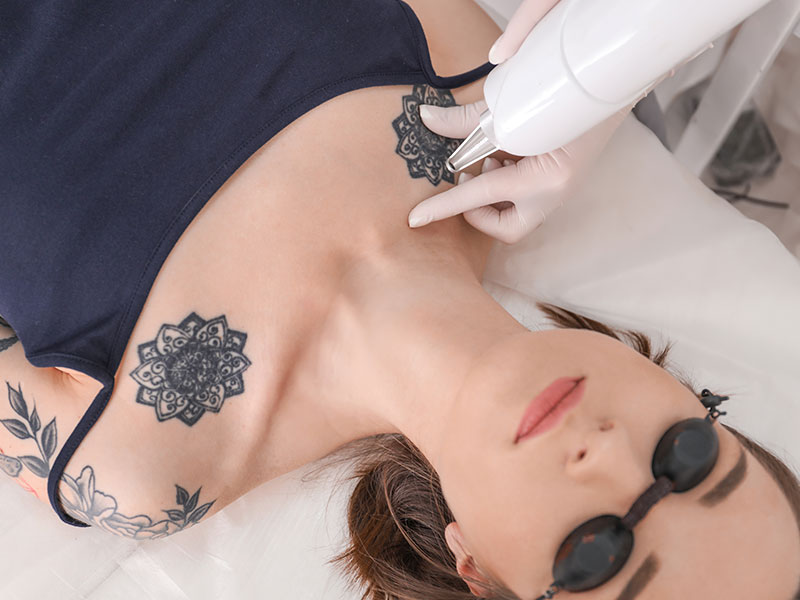

Pico laser tattoo removal uses very short pulses of laser energy to fragment selected tattoo pigments within the skin. The smaller pigment particles may then be gradually cleared by the body over time.
Pico laser systems are among the technologies that may be considered for tattoo removal, but they are not automatically faster, safer or more effective than every other laser in all circumstances.
The outcome depends on the tattoo’s colour, pigment composition, depth, density, age and location, as well as the available laser wavelengths, the individual’s skin tone and the body’s response.
The initial consultation is therefore an essential part of treatment planning.
What Is Pico Laser Tattoo Removal?
Pico lasers deliver pulses measured in picoseconds, which are extremely short fractions of a second. These pulses create a photoacoustic effect that helps break tattoo pigment into smaller particles.
The treatment does not physically remove all ink during the appointment. Fading develops gradually during the weeks following each session.
Several sessions are usually required, and complete removal cannot be guaranteed.
Pico laser technology may be useful for selected dark and coloured pigments, but no single laser wavelength removes every colour equally well.
Black pigment often responds more predictably because it absorbs a broad range of laser wavelengths. Other colours may require a wavelength specifically suited to that pigment.
Green and blue pigments may respond to selected devices, but the result depends on the exact ink composition and laser system.
Yellow, white, flesh-toned, fluorescent and certain cosmetic tattoo pigments can be particularly resistant. Some light-coloured pigments may darken after laser exposure.
Why Is the Initial Consultation Important?
The initial consultation allows the practitioner to examine the tattoo, evaluate possible risks and establish realistic expectations.
The consultation should clarify:
-
Whether the tattoo is likely to respond
-
Which laser wavelength may be used
-
Whether a test spot is appropriate
-
The possibility of incomplete removal
-
Approximate treatment intervals
-
Possible side effects
-
Expected recovery
-
Aftercare requirements
-
Alternative treatment options
-
Estimated total cost
The treatment plan should be individualised rather than based only on the general claim that pico lasers are advanced technology.
What Information About the Tattoo Is Reviewed?
When Was the Tattoo Applied?
Older tattoos may sometimes respond differently from recently applied tattoos because pigment density and distribution may change over time.
However, age alone does not determine how easily a tattoo can be removed.
Is It a Professional or Amateur Tattoo?
Professional tattoos often contain more pigment and may have been placed at a more uniform or deeper level.
Amateur tattoos may contain less ink but can have uneven depth.
Neither type can be assumed to be easier in every case.
What Colours Are Present?
The practitioner should identify all visible colours and explain which wavelengths are available for them.
A tattoo containing black, red, green and blue may require more than one wavelength or treatment strategy.
The visible colour does not always reveal the complete chemical composition of the pigment.
Is It a Cover-Up or Layered Tattoo?
Cover-up tattoos may contain several layers of ink at different depths.
As the upper pigment fades, previously hidden colours or designs may become visible.
Layered tattoos may require more sessions and may not clear uniformly.
Where Is the Tattoo Located?
Body location can influence the rate of fading.
Tattoos on the hands, feet and lower legs may respond more slowly than tattoos on areas with stronger circulation.
The location also affects friction, swelling, wound care and return to daily activities.
Is There Existing Scar Tissue?
Some tattoos contain scar tissue from the original tattooing procedure.
Laser treatment may reveal pre-existing scars as the pigment fades. The scar should therefore be documented before treatment begins.
Medical History Discussed During the Consultation
The practitioner should review the individual’s medical and dermatological history.
Important information includes:
-
Current medication
-
Blood-thinning medication
-
Photosensitising medication
-
Allergies
-
Previous laser procedures
-
Previous reactions to tattoo pigment
-
History of herpes infection
-
Keloid or abnormal scarring tendency
-
Autoimmune conditions
-
Bleeding disorders
-
Active skin disease
-
Pregnancy or breastfeeding
-
Recent tanning or sunburn
-
Previous tattoo-removal attempts
Prescription medication should never be stopped without approval from the physician who prescribed it.
Treatment may need to be postponed when there is an active infection, open wound, severe irritation or recent sunburn in the treatment area.
Skin Tone and Pigmentation Risk
Natural skin tone is an important part of laser selection and energy planning.
Melanin in the surrounding skin can also absorb laser energy. This may increase the risk of burns, temporary darkening or lightening, particularly in darker or recently tanned skin.
A darker skin tone does not automatically prevent treatment, but conservative settings, an appropriate wavelength and longer intervals may be required.
The practitioner should ask whether the individual has previously developed:
-
Dark marks after inflammation
-
Light patches after injury
-
Pigmentation after laser treatment
-
Keloid or raised scars
Expectations Discussed During the Consultation
Tattoo removal should be approached as a gradual fading process.
The individual should understand that:
-
Complete removal may not be possible
-
A faint outline may remain
-
Some colours may be resistant
-
Different areas may fade unevenly
-
Pigment may change colour
-
Texture changes may remain
-
Multiple sessions may be required
-
Treatment may take many months
The number of sessions cannot be predicted precisely from the tattoo’s appearance alone.
A practitioner may provide an approximate range, but this should not be presented as a guarantee.
Questions About Previous Removal Treatments
If the tattoo has previously been treated, the practitioner should ask:
-
Which technology was used
-
How many sessions were performed
-
When the last treatment took place
-
Whether blistering or infection occurred
-
Whether the pigment changed colour
-
Whether scarring developed
-
How much fading was achieved
Previously treated skin may respond differently and may require additional healing time before another procedure.
How Does a Pico Laser Work?
Pico laser pulses produce rapid energy delivery that can fragment selected pigment particles through a strong photoacoustic effect.
The body may gradually process some of the fragmented pigment through immune and lymphatic mechanisms.
This process takes time. Performing sessions too close together does not necessarily remove the tattoo faster and may increase the risk of skin injury.
Pico lasers still produce heat and tissue stress. They should not be described as causing no damage to surrounding skin.
Can Every Tattoo Colour Be Removed?
No.
Treatment response depends on the relationship between the ink colour and the laser wavelength.
Black and Dark Pigments
Black and certain dark blue pigments often respond more predictably, but complete clearance is not guaranteed.
Red and Orange Pigments
Some red and orange inks may respond to selected wavelengths.
However, these pigments can occasionally be associated with allergic reactions, which may affect the treatment plan.
Green and Blue Pigments
Green and blue may respond when the appropriate wavelength is available, but some formulations remain difficult to treat.
Yellow and Light Pigments
Yellow, white, flesh-toned and fluorescent pigments are often difficult to target.
Pigments containing iron or titanium compounds may darken after laser treatment.
For this reason, a test spot may be particularly important for cosmetic tattoos and light-coloured pigments.
Is Pico Laser Always Better Than Q-Switched Laser?
Not necessarily.
Pico and Q-switched lasers use different pulse durations, but treatment success also depends on:
-
Wavelength
-
Energy setting
-
Spot size
-
Practitioner experience
-
Tattoo characteristics
-
Skin tone
-
Treatment interval
-
Aftercare
A suitable Q-switched laser may produce a good response in some tattoos, while a pico laser may offer an advantage for selected resistant pigments.
The treatment should be chosen according to the tattoo rather than the popularity of the device name.
What Happens During the Procedure?
The skin is examined and cleaned before treatment. Protective eyewear is required for everyone in the treatment room.
Cooling, topical anaesthetic or another comfort method may be used depending on the tattoo location and individual sensitivity.
The laser is then applied to the tattoo using settings selected for the pigment and skin characteristics.
The sensation may be described as:
-
Stinging
-
Snapping
-
Heat
-
Burning
-
A rubber band striking the skin
The procedure may be uncomfortable despite anaesthetic measures.
The duration depends on the tattoo’s size, location, colour and complexity. A standard treatment time of 10 to 30 minutes does not apply to every tattoo.
What Can Be Expected Immediately After Treatment?
The treated area may temporarily develop a white or frosted appearance.
Other expected reactions may include:
-
Redness
-
Swelling
-
Tenderness
-
Warmth
-
Pinpoint bleeding
-
Blistering
-
Crusting
-
Itching
These reactions may last for several days or longer, depending on treatment intensity and individual healing.
Increasing pain, spreading redness, pus, fever or an unpleasant odour may indicate infection and requires medical assessment.
Healing Process
Healing is not always rapid or complication-free.
Mild redness and swelling may settle within a few days, while blisters, crusting or pigment changes may require a longer period.
The skin should be fully recovered before the next session.
Possible complications include:
-
Infection
-
Prolonged redness
-
Persistent hyperpigmentation
-
Hypopigmentation
-
Texture change
-
Allergic reaction
-
Scarring
Rare complications remain possible even when treatment is performed correctly.
Aftercare Following Pico Laser Tattoo Removal
Wound Care
The practitioner should provide specific instructions based on the condition of the treated skin.
The area may require gentle cleaning, a recommended ointment or a suitable dressing.
Open, blistered or crusted skin should not be covered with random cosmetic products.
Do Not Pick the Skin
Blisters should not be intentionally opened, and crusts should not be removed manually.
Picking may increase the risk of infection, pigment changes and scarring.
Avoid Friction
Tight clothing, footwear or repetitive movement may irritate the treatment area.
The area should be protected from rubbing until the surface has healed.
Avoid Irritating Products
Retinoids, exfoliating acids, alcohol-based products, fragrances and scrubs may need to be avoided temporarily.
Sun Protection
Sun exposure before or after treatment may increase the risk of pigment changes.
Freshly treated skin should initially be protected with clothing or another physical covering when sunscreen cannot be applied safely.
Sunscreen should not be applied indiscriminately to open, blistered or actively weeping skin.
Once the skin surface has healed sufficiently, broad-spectrum sunscreen may be used according to professional advice.
Additional measures include:
-
Avoiding intentional tanning
-
Avoiding tanning beds
-
Wearing protective clothing
-
Staying in the shade
-
Reapplying sunscreen when appropriate
Should the Skin Be Kept Moist?
The instruction to keep the skin moist should only be followed as part of a defined wound-care plan.
A thin layer of an approved ointment may be recommended in some cases. In others, excessive moisture or occlusive products may increase irritation.
The appropriate care depends on whether the skin is intact, blistered, crusted or open.
Returning to Daily Activities
Many individuals can continue light daily activities after treatment.
However, activities that produce heat, sweating, friction or contamination may need to be postponed.
Temporary restrictions may include:
-
Strenuous exercise
-
Swimming
-
Saunas
-
Steam rooms
-
Very hot baths
-
Contact sports
-
Shaving over the area
-
Prolonged sun exposure
The duration of these restrictions should be determined according to healing rather than a fixed schedule.
Questions to Ask During the Initial Consultation
Useful questions include:
-
Which pico laser and wavelength will be used?
-
Which tattoo colours are expected to respond?
-
Could any pigment become darker?
-
Would a test spot be appropriate?
-
Is complete removal realistic?
-
How many sessions may be required?
-
How long should there be between sessions?
-
What side effects are possible?
-
What aftercare will be required?
-
What signs indicate a complication?
-
What is the total expected cost?
-
What alternatives are available?
The practitioner should provide clear and realistic answers rather than promising complete removal.
Pico Laser Tattoo Removal at Ankara Laser
Ankara Laser or another qualified medical provider should assess the tattoo and medical history before treatment.
The consultation should explain:
-
Practitioner qualifications
-
Device and wavelength
-
Expected response of each pigment
-
Possibility of residual ink
-
Risk of colour change
-
Treatment intervals
-
Possible complications
-
Aftercare support
-
Follow-up arrangements
Treatment should not be selected solely because the device is marketed as newer or more advanced.
Frequently Asked Questions
How Many Sessions Are Required?
There is no fixed number.
Tattoo colour, density, depth, size, location and previous treatment response all affect the number of sessions.
Does Pico Laser Remove Every Tattoo Completely?
No.
Some tattoos fade substantially, while others leave residual colour, an outline or texture changes.
Is the Procedure Painless?
No. Stinging, heat or a snapping sensation may occur.
Cooling or topical anaesthetic may reduce discomfort but may not eliminate it.
Is Healing Always Fast?
No.
Mild reactions may resolve quickly, but blistering, crusting and pigment changes can require a longer recovery period.
Can Scarring Occur?
Yes, although it does not occur in every individual.
The risk may increase with infection, excessive energy, poor aftercare, premature repeat treatment or abnormal scarring tendency.
Can All Colours Be Treated?
Different colours require different wavelengths.
White, flesh-toned, yellow and some cosmetic pigments may respond poorly or darken.
Are the Results Permanent?
Pigment successfully fragmented and cleared does not normally reform. However, residual ink may remain, and complete removal cannot be guaranteed.
In conclusion, the initial consultation for pico laser tattoo removal should assess the tattoo’s colours, depth, density, age, location, previous treatments and the individual’s skin tone and medical history. It should also establish realistic expectations regarding session numbers, incomplete clearance, pigment darkening, recovery and possible complications.
 Call
Call
 Whatsapp