


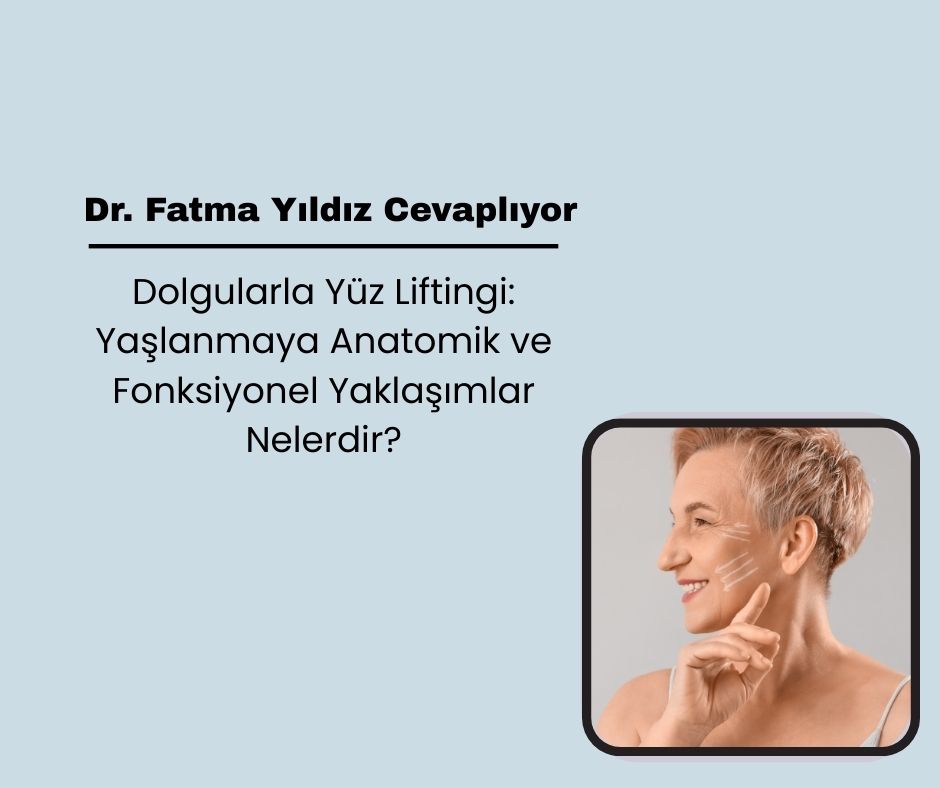

What is Face Lift with Fillers?
While filler applications were initially two-dimensional procedures aimed at filling wrinkles and grooves, today they have evolved into a multi-layered and three-dimensional approach. Increasing knowledge about the aging process on the face has made the use of filler applications widespread as a lifting tool for not only the surface but also the deep tissues.
2. Facial Aging and Anatomical Layers
The face consists of five basic anatomical layers:
Skin
Subcutaneous tissue
Musculoaponeurotic system (SMAS)
Subaponeurotic tissue and ligaments
Periost and deep fascia
All of these layers are affected by the aging process. In particular, bone resorption and soft tissue loss lead to significant changes in facial morphology. The effects of these changes on the surface are observed as sagging, wrinkles and contour losses.
3. Bone Skeleton and Aging
With age:
Maxilla and mandible recede.
Inferior orbital rim support decreases, under-eye grooves become more prominent.
Nasolabial groove deepens.
Mandibular angle widens, jowl formation increases.
These bone changes provide insufficient support to the soft tissues above them, causing deterioration of the facial contour.
4. Changes in Fat Compartments
Fat pads lose volume with age. This causes:
Compartment separation
Sagging
Pseudoptosis (false sagging)
The weakening of the retaining ligaments also plays a decisive role in this process.
5. Aging Theories: Gravitational vs Volumetric
There are two main theories regarding facial aging:
Gravitational theory: Ligamentous structures weaken, soft tissues are displaced downward by gravity.
Volumetric theory: Volume loss in the face (especially in the fat compartments) is the main reason for morphological changes.
Today, these two approaches are evaluated together. Modern lifting applications target both volume restoration and tissue support.
6. Filler Lifting Applications
Modern filler applications:
They are applied to bone and deep fat compartments.
Soft tissues are reconstructed by applying more volume to deeper layers.
They are called “Liquid lifting”, “Volumetric lifting” or “Filler face lift”.
Success in these applications depends not only on material knowledge but also on mastering the anatomy of aging.
 Call
Call
 Whatsapp