


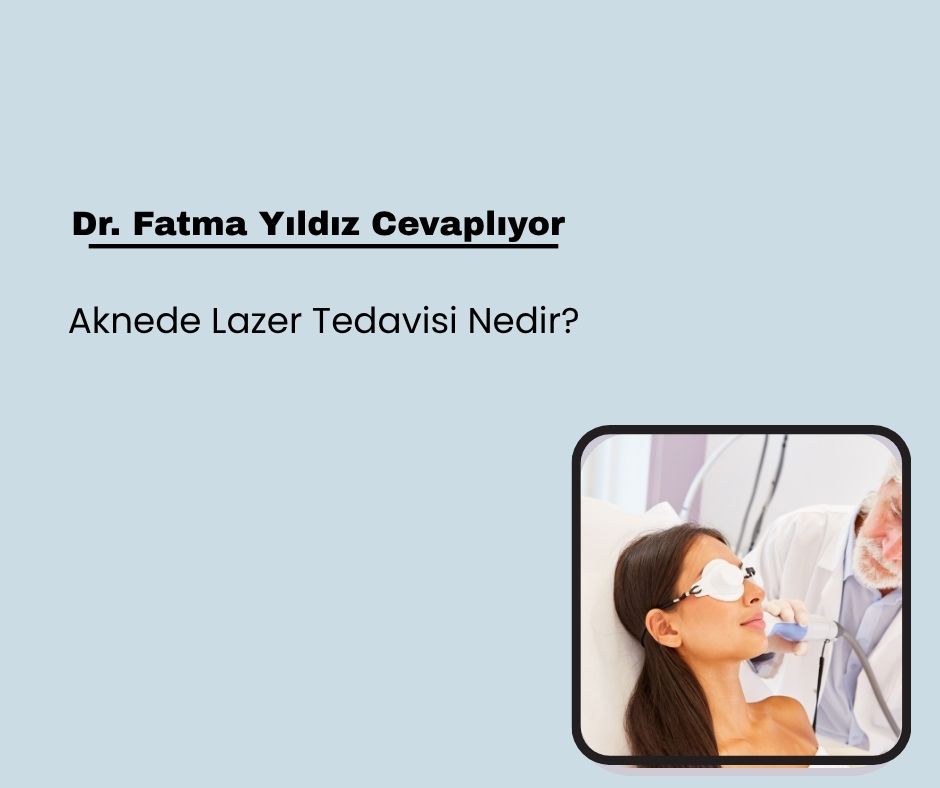

What is Laser Treatment for Acne?
Effectiveness, Methods and Recent Developments
Acne vulgaris continues to be one of the most common complaints of patients applying to dermatology clinics today. Acne patients constitute more than 30% of all dermatological diseases, which reveals how widespread a problem acne vulgaris is. This disease, which has a multifactorial pathogenesis in which genetic and hormonal factors are effective, manifests itself with lesions such as comedones, papules, pustules, nodules and cysts.
There are four main mechanisms in the development of acne:
Follicular epidermal hyperproliferation
Increased sebum production
Propionibacterium acnes (P. acnes) colonization in the follicle
Inflammation
What is Laser Acne Treatment?
Although topical and systemic drugs are at the forefront in traditional treatments, laser and light treatments have become a remarkable option in recent years, especially in resistant and severe cases. These lasers are generally divided into two groups:
Lasers that destroy the sebaceous glands and pilosebaceous unit (such as infrared lasers and radiofrequency devices)
Light systems targeting P. acnes (such as blue/red light, KTP laser, PDL, IPL)
KTP Laser (532 nm)
Potassium Titanyl Phosphate (KTP) laser is effective in vascular lesions as well as increasing collagen production. It is widely used in facial and leg telangiectasis. Although its effect on acne is not fully known, it is thought to work with a photothermolysis or photodynamic effect mechanism.
???? In a study, in patients who received 4 sessions of KTP laser twice a week, acne severity decreased by 34.9% after 1 week and 20.7% after 4 weeks.
Pulsed Dye Laser (PDL) (585-595 nm)
PDL targets oxyhemoglobin by emitting yellow light and is especially effective in inflammatory lesions. It stimulates collagen synthesis with dermal remodeling effect.
???? In the study of Seaton et al., a 49% decrease in inflammatory lesions and a 53% decrease in the total number of lesions were observed after 12 weeks. However, it is recommended to use it carefully due to the risk of temporary purpura and hyperpigmentation.
Nd:YAG Laser (1320 nm)
Neodymium:Yttrium Aluminum Garnet (Nd:YAG) lasers can reach a depth of 5-8 mm and are generally used for vascular lesions. In acne treatment, positive results have been obtained for both inflammatory and non-inflammatory lesions.
???? In the study conducted by Deng et al., inflammatory lesions were reduced by 57% and non-inflammatory lesions by 35% after 6 sessions.
Diode Laser (1450 nm)
The FDA-approved 1450 nm diode laser causes thermal damage to the sebaceous glands by targeting water molecules. Thus, sebum production decreases and inflammatory lesions regress.
???? In the study by Astner and Tsao, inflammatory lesions decreased by 39% after 3 sessions.
Friedman et al. reported an 83% decrease after the third session.
Er: Glass Laser (1540-1550 nm)
The Erbium Glass laser increases collagen production by targeting intracellular water and can penetrate up to 2 mm deep. It is especially effective in inflammatory lesions.
???? In the study conducted by Bogle et al., 68% of patients reported improvement after 6 months.
In the study by Moneib et al., a significant decrease in inflammatory lesions and shrinkage in sebaceous glands were detected after a one-year follow-up.
Radiofrequency (RF) Treatment
RF devices work by creating heat in the dermis using electric current instead of light. In this way, sebaceous glands can be targeted without damaging the epidermis. RF systems are generally divided into three: monopolar, bipolar and fractional microneedle.
???? In the study by Kim et al., a significant decrease in inflammatory lesions, a decrease in sebum production, and an increase in patient satisfaction were observed.
???? Lee et al. observed improvement in inflammatory lesions up to grade 4 after RF application.
Conclusion: Laser Acne Treatment is Safe and Effective
Laser and light-based treatments are a strong alternative to topical and systemic treatments for patients who want fast results. However, correct patient selection is extremely important to reduce the risk of side effects. Although the results of the studies conducted to date are positive, studies with longer-term follow-ups are needed in larger patient groups.
 Call
Call
 Whatsapp