


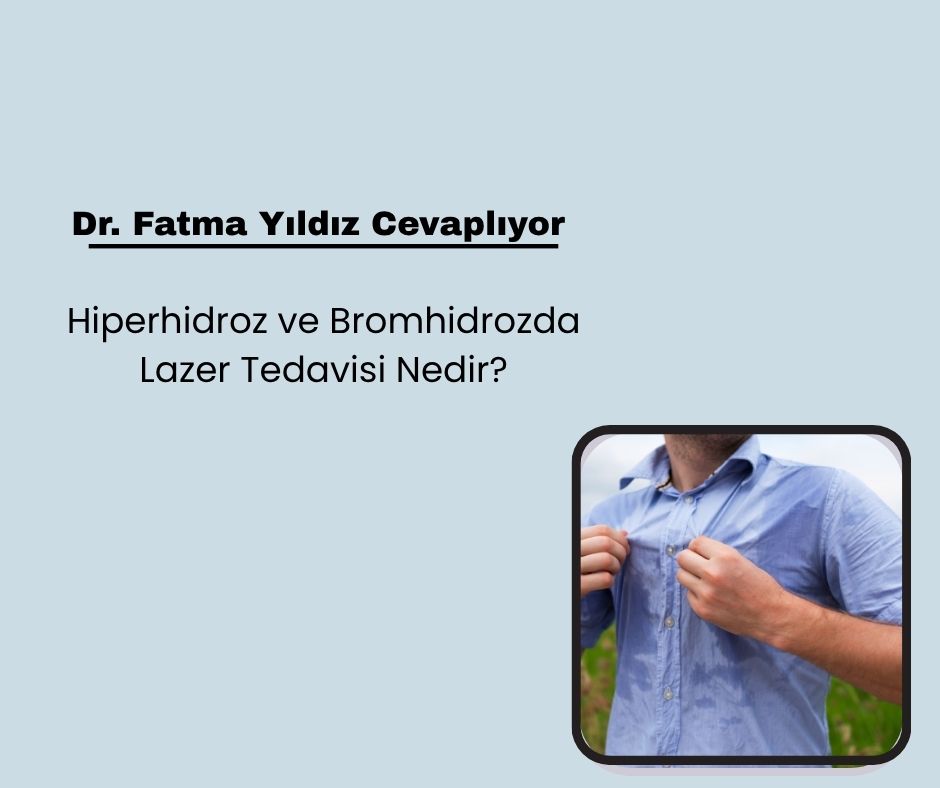

What is Laser Treatment for Hyperhidrosis and Bromhidrosis?
Is it an Effective Alternative?
Excessive sweating (hyperhidrosis) and bad body odor (bromhidrosis) are two important dermatological problems that negatively affect the quality of life both physically and psychologically. In addition to traditional treatments, laser treatments have become a remarkable option in the management of these two problems in recent years.
What is Hyperhidrosis?
Hyperhidrosis is a condition of excessive sweating caused by excessive sweat glands. It is usually limited to areas such as the armpits, palms and soles and is called local idiopathic hyperhidrosis. It is most often triggered by emotional stimuli and can seriously restrict the individual's social life.
Topical agents (e.g. aluminum chloride), iontophoresis, botulinum toxin applications and surgical interventions are among the classical treatment options for this condition.
What is Bromhidrosis?
Bromhidrosis (osmidrosis) is an intense and disturbing body odor caused by apocrine sweat glands, especially in the armpit. It is usually seen together with hyperhidrosis. It can stain clothes and cause embarrassment in social relationships. The odor is sharper and more pronounced in apocrine bromhidrosis.
Treatment methods include topical antibacterial products, systemic anticholinergics and surgical methods.
Laser Applications: A New Solution for Hyperhidrosis and Bromhidrosis?
With the developing technology in recent years, laser systems have become a promising, minimally invasive option for these two dermatological problems. It is aimed to target both the glands that cause sweating and bad odor with different laser wavelengths and methods.
Nd:YAG Laser
1064 nm Nd:YAG laser is applied subdermally in the treatment of hyperhidrosis. It provides an effective result by targeting the sweat glands.
With the “LARAH” method, tissue residues are removed with the help of a probe after the laser.
It has been reported in the studies that it provides safe, fast and permanent results.
Diode Laser
Studies conducted with diode lasers of 924 nm and 975 nm wavelengths have shown that laser application alone or in combination with curettage is effective.
The best results were obtained in the combination of laser + curettage.
Another study conducted with 800 nm wavelength reported visible improvements.
Laser Options in Bromhidrosis (Osmidrosis) Treatment
CO2 Laser
Apocrine glands are targeted by vaporizing the subcutaneous tissue with laser.
It provides fewer complications and shorter recovery time compared to classical surgery.
Up to 90% patient satisfaction has been reported.
Nd:YAG Laser (SmartLipo etc.)
Laser is applied to the subcutaneous area via microcanula.
Studies conducted with 1440-1444 nm lipolysis Nd:YAG laser have shown successful results especially in mild-moderate osmidrosis.
It has advantages such as leaving small scars and returning to normal life in a short time.
Disadvantages and Limitations
Complications such as burns, erosions or temporary hyperpigmentation may occur on the skin.
In severe cases, laser treatment may be insufficient and more invasive methods may be required.
Although the effect of laser usually lasts for 1 year, re-treatment may be required in some cases.
Conclusion
Laser treatments stand out as an effective and safe option for both hyperhidrosis and bromhidrosis. With their minimal invasiveness, short recovery time and high patient satisfaction, these treatments are expected to become more widespread in the future.
However, the patient's clinical condition, sweating/odor severity and individual preferences should be taken into consideration in the selection of treatment; and when necessary, they should be combined with classical methods.
 Call
Call
 Whatsapp