


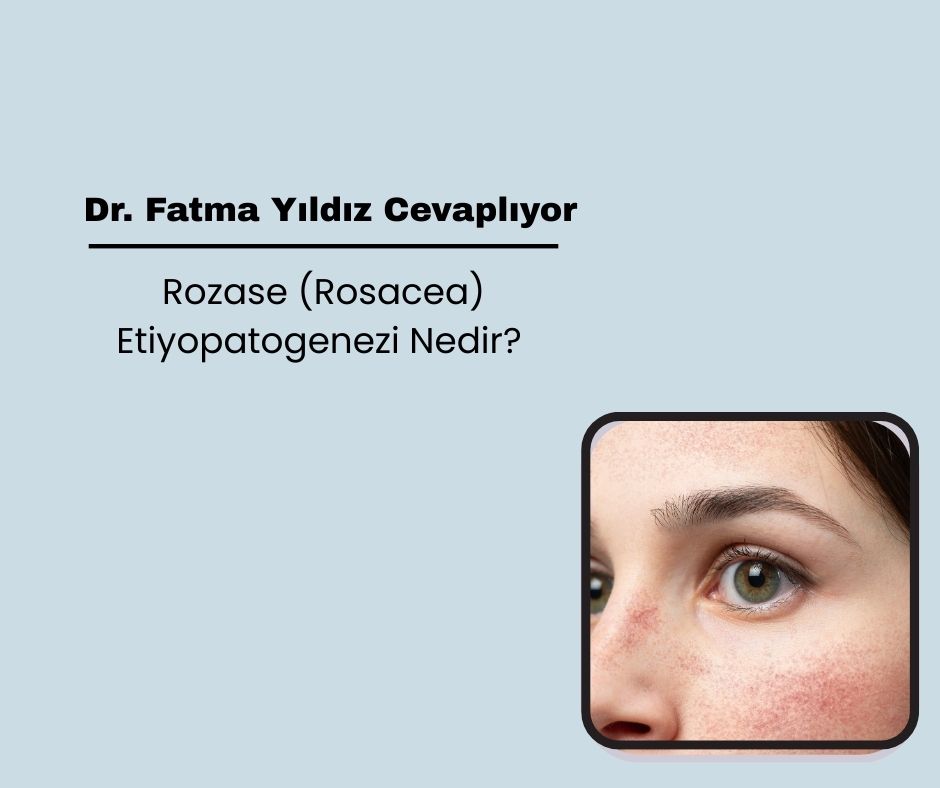

What is the Etiopathogenesis of Rosacea?
Rosacea is a chronic inflammatory skin disease that affects the face. Clinically, it is characterized by attacks of redness, persistent erythema, papules, pustules and telangiectasias. It usually shows a symmetrical distribution on the cheeks, nose, forehead and chin. The disease often occurs in the 30s-40s; it is more common in women, but more severe in men.
1. Rosacea Subtypes
Rosacea is divided into four main clinical subtypes:
Erythematotelangiectatic rosacea
Papulopustular (inflammatory) rosacea
Phymatous rosacea
Ocular rosacea
There may be transitions between the subtypes and the clinical severity may vary from person to person.
Etiology and Pathogenesis
Although the exact cause of rosacea is not known, many factors play a role in the development of the disease. These factors can be examined under four main headings:
1. Predisposing Factors
a. Genetic Predisposition
It is more common in fair-skinned individuals and those with a family history.
Genetic studies have shown a relationship with polymorphisms in genes such as HLA-DRA, BRNL2, GSTM1, GSTT1 and NOD2/CARD15.
These genetic changes are associated with increased oxidative stress, immune dysregulation and inflammatory responses.
b. Relationship with Systemic Diseases
Rosace has been associated with inflammatory bowel diseases such as ulcerative colitis, Crohn's disease, celiac disease.
Cardiovascular diseases (hypertension, dyslipidemia, coronary artery disease) are more common in rosacea patients.
It has also been found to be associated with type 1 diabetes, insulin resistance and metabolic syndrome.
An increase in neurological and neurodegenerative diseases such as migraine, depression, Parkinson's and dementia has been observed in rosacea patients. This condition is associated with increased expression of matrix metalloproteinase (MMP).
2. Triggering Factors
a. Ultraviolet (UV) Exposure
The increase in lesions in sun-exposed areas and the fact that UV causes histological changes such as actinic elastosis indicate that UV is effective in the pathogenesis of rosacea.
UV, especially UVA and UVB:
It causes the deterioration of dermal structures and vascular proliferation by increasing the expression of MMP-1, VEGF, FGF2.
It creates oxidative stress by increasing the production of reactive oxygen species (ROS).
It triggers endoplasmic reticulum (ER) stress and leads to an increase in cathelicidins such as LL-37.
It stimulates inflammation via TLR2 / MyD88 signaling pathways.
3. Microbial Stimulation
a. Demodex Colonization
Demodex folliculorum and Demodex brevis mites are found in higher than normal densities in individuals with rosacea.
The chitin content and bacterial loads of these parasites trigger an inflammatory response via TLR2 activation.
Other microbial factors (e.g. Helicobacter pylori or Staphylococcus epidermidis) can then be considered.
Conclusion
Rosacea is a chronic disease with a multifactorial etiology. Genetic predisposition, immune dysregulation, environmental triggers (UV, microbial factors) and comorbidities are effective on the development and severity of rosacea. Understanding the mechanisms involved in pathogenesis is important for the development of targeted treatment options.
 Call
Call
 Whatsapp