


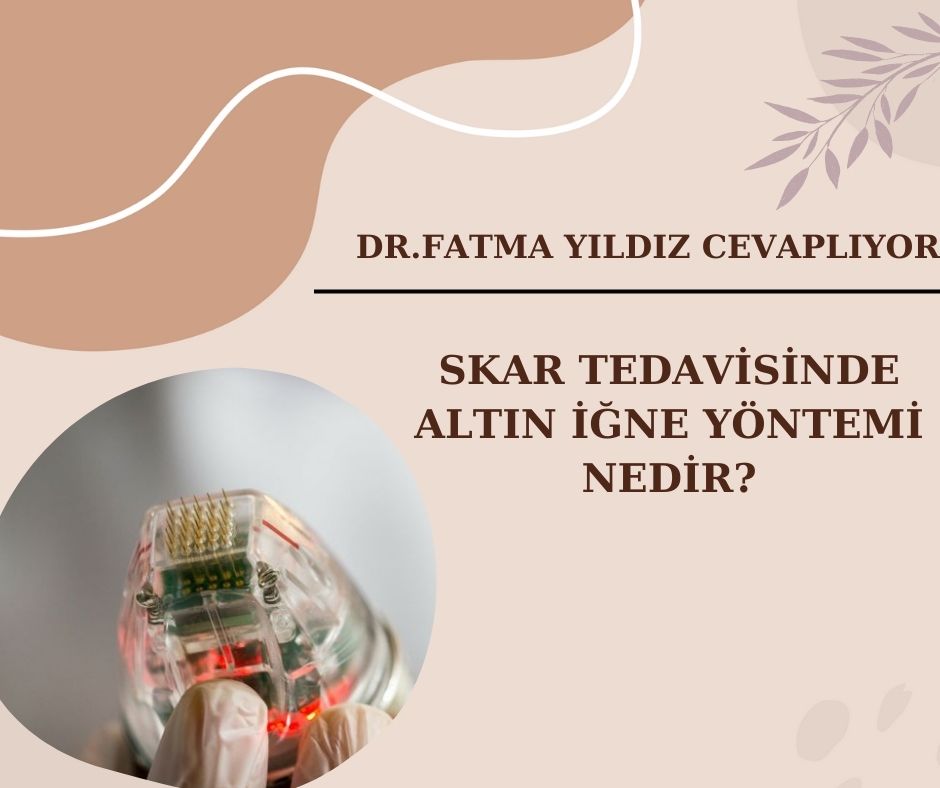

What is the Gold Needle Method in Scar Treatment?
Scars are common sequelae that can occur after various conditions such as acne, hidradenitis suppurativa, surgical interventions, traumas and burns and can seriously affect the individual's quality of life. Scar formation can be a result of the normal skin tissue repair process, as well as different types of scars can occur due to abnormal healing processes. These scars include:
Extended scars,
Atrophic scars,
Hypertrophic scars,
Keloid scars,
Scar contractures.
Mechanism of Scar Formation
During normal wound healing, a balanced process is carried out between collagen biosynthesis and matrix degradation. However, this balance is disrupted in abnormal healing situations. As a result, proliferative scars, especially hypertrophic scars and keloids, develop. In this case:
Hypertrophic scars are raised scars that remain within the boundaries of the wound,
Keloid scars, on the other hand, spread beyond the boundaries of the wound and affect a larger area.
Atrophic scars, on the other hand, are sunken and depressed lesions of the skin that occur when sufficient dermal collagen and connective tissue cannot be produced.
Traditional Scar Treatment Methods
Traditionally, various methods have been used in the treatment of scars:
Surgical techniques,
Dermabrasion,
Chemical peeling,
Topical silicone gels,
5-fluorouracil injections,
Dermal filler applications or autologous fat transfer (especially for atrophic scars),
Intralesional corticosteroid injections (especially for hypertrophic scars).
However, in some patients, there is no response to these treatments or the treatment process may be limited due to side effects. Therefore, the need for alternative treatment options has increased.
Effects and Limitations of Laser Treatments on Scars
Although laser treatments (especially ablative lasers such as carbon dioxide laser and Erbium:YAG laser) have been used in scars, complications such as:
Delayed erythema,
Permanent hyperpigmentation,
Prolonged healing times,
Risk of infection,
Worsening of scarring
may occur in these treatments, which limits the use of laser treatments.
A New Approach to Scar Treatment: Radiofrequency and Plasma Energy
In recent years, plasma radiofrequency (PRF) ablation has been developed as a result of the search for scar treatment with minimally invasive and safe technologies with fewer side effects.
In PRF technology:
Ionized energy is produced using a plasma radiofrequency device,
The tissue is thermally heated in a uniform and controlled manner,
Healing is achieved on the skin surface with the effect of sublimation (transition from solid to gas phase).
Thanks to this method, a controlled repair process can be initiated directly in the dermal layers without excessive damage to the epidermis.
Mechanism of Radiofrequency in Scar Treatment
Radiofrequency safely transmits heat energy to specific layers of the skin using radio waves. In particular:
Not the uppermost layers of the skin,
but the collagen in the lower layers is targeted.
In this process:
Collagen fibers are denatured (broken down) in a controlled manner,
New collagen production is triggered,
Scars gain a more regular and smooth appearance over time.
This healing process continues over time and a significant reduction in scars is achieved.
Clinical Studies and Results
In clinical studies conducted:
Radiofrequency ablation (RFA) treatment,
was found to be superior to traditional intralesional 5-fluorouracil (5-FU) injections.
Moreover, in these treatment protocols:
No serious side effects were observed,
Patient satisfaction was found to be high.
These results show that radiofrequency energy offers an effective and safe alternative in scar treatment.
Gold Needle (Microneedle Radiofrequency) Method in Scar Treatment
Especially microneedle fractional radiofrequency (RF) systems known as gold needle:
Supports collagen remodeling (restructuring) by delivering energy directly to the dermis,
Minimizes epidermal damage,
Shortens healing time and reduces the risk of side effects.
Thanks to these features, it provides promising results in the treatment of atrophic, hypertrophic and mixed type scars.
 Call
Call
 Whatsapp