


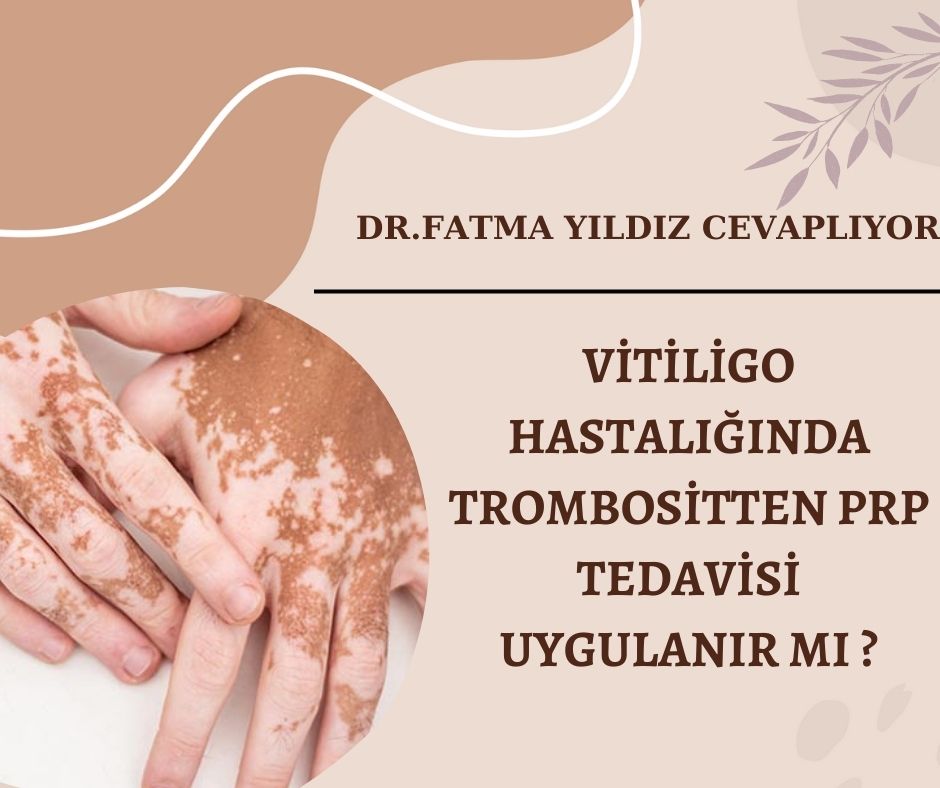

What is Vitiligo? Is PRP Treatment Applied from Platelets?
Vitiligo Platelet-Rich Plasma and PRP Treatment; Vitiligo is a disease that causes skin discoloration and in which the immune system mistakenly attacks the cells that give color to the skin. It is seen in approximately 0.5-2% of the world's population and occurs equally between men and women. Most people are diagnosed before the age of 30, and children can also be affected. Everyone has the same risk of catching it, but it is usually noticed in people with light skin after exposure to the sun in the summer.
Psychological Effects of Vitiligo
Vitiligo, especially when it occurs in visible areas, seriously affects people's quality of life. This condition can cause low self-confidence, shame, anxiety, depression and problems in social relationships. Psychological effects can be deeper and more permanent in children and adolescents.
What Causes Vitiligo?
The exact cause of the disease is not known. However, it is thought that genetic predisposition, environmental factors, stress and malfunctioning of the immune system are effective.
Treatment Methods
The purpose of vitiligo treatment:
To stop the progression of the disease,
To restore lost skin color (repigmentation),
To ensure that the color is preserved after treatment.
Treatment methods include:
Creams and Medicines: Cortisone or immunosuppressive creams applied to the skin.
Light Therapy: Special ultraviolet lights are used.
Laser Treatment: It can be effective especially for resistant areas.
Surgical Methods: Transplantation of skin color cells.
PRP Treatment (Platelet Rich Plasma): Growth factors obtained from the patient's own blood are applied to the skin.
What is PRP Treatment?
PRP is prepared from the person's own blood. This blood is separated with special methods and made rich in platelets (healing cells of the blood). Platelets help renew skin cells. PRP is used in many areas such as hair loss, wound healing and skin renewal.
The Role of PRP in Vitiligo
Although PRP (Platelet-Rich Plasma) treatment in vitiligo has become widespread in recent years, studies in this area are still limited. Vitiligo is a condition known as the Koebner phenomenon, where skin traumas can trigger lesions of the disease. For this reason, patients who receive PRP treatment are usually selected from stable vitiligo patients. The effectiveness of PRP in the treatment of vitiligo has generally been more evident in studies where it was applied together with other treatments.
For example, Rekik et al. investigated the effectiveness of PRP in stable vitiligo patients resistant to conventional treatments and observed that 40% of the patients achieved more than 50% repigmentation in at least one lesion. In addition, no recurrence was detected in the patients after 6 months of follow-up. Another study revealed that PRP increased the effectiveness when used together with UVB light therapy, a dermatological treatment, in patients with symmetric stable vitiligo. In the areas where PRP treatment was applied, a perfect response rate of 55% was observed and no recurrence was observed even after 7 months in the areas where this treatment was applied.
The combination of Excimer laser and PRP is another method examined in the treatment of vitiligo. A study has shown that the combination of Excimer laser treatment and PRP is much more effective compared to laser treatment alone. It has been determined that the combination of PRP and Excimer laser increases response rates and decreases recurrence rates.
However, many studies have been conducted on the combined use of fractional CO2 laser and PRP. This treatment combination has yielded better results compared to other treatments. The combination of fractional CO2 laser treatment and PRP created a synergistic effect and accelerated the response to the treatment. In another study, the combination of mini-punch grafting and PRP was also examined, but the results were that PRP accelerated repigmentation but did not make a significant contribution to the treatment process.
In conclusion, studies on the effectiveness of PRP in the treatment of vitiligo show that PRP provides more benefits, especially when combined with other treatment methods. However, it is concluded that more studies and research are required.
 Call
Call
 Whatsapp