


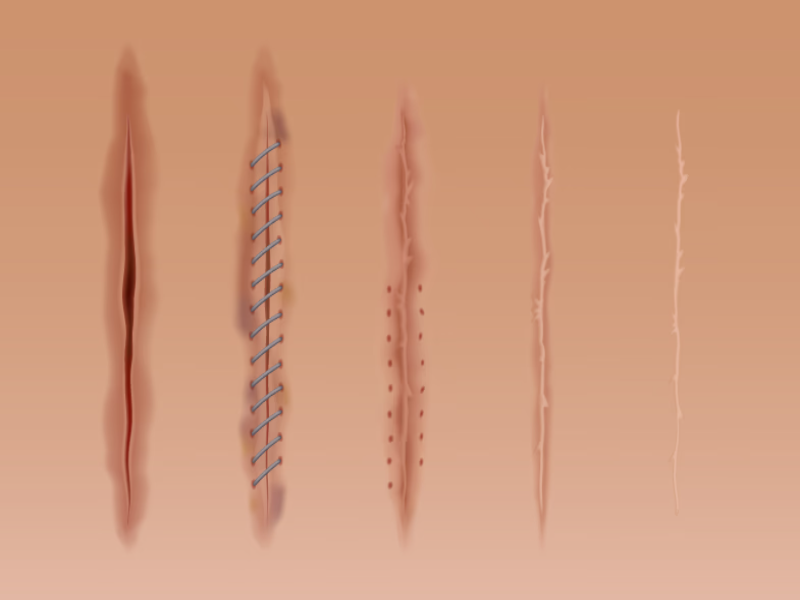

A surgical stitch scar is a type of scar that can remain after surgery or an injury that required sutures. These scars often appear as linear marks, although their final appearance depends on wound location, tension, closure technique, infection, individual healing response, and genetic tendency.
Because every person's healing response is different, surgical scars can vary considerably. Some become flat and relatively inconspicuous over time, while others may remain wide, raised, depressed, discolored, or symptomatic. Wound care, skin characteristics, genetics, wound tension, and complications can all influence their appearance.
Different treatments may be considered to reduce the visible appearance or symptoms of surgical scars. Surgical Stitch Scar Treatment should be selected according to scar type and characteristics rather than with the expectation of complete removal.
Common Types of Scars Considered for Surgical Stitch Scar Treatment
Surgical stitch scar treatment is primarily intended for scars that developed after wounds were closed with sutures. Scar and Wound Scar describe overlapping concepts, while Stretch Marks are a different condition and are not surgical stitch scars.
Surgical scars may become flat, widened, hypertrophic, keloid, depressed, pigmented, or contracted. Treatment varies considerably according to these characteristics and the scar's location and maturity.
The term wound scar generally refers to a scar left after an injury. Such scars are not automatically superficial; a wound may produce either a mild or deep structural scar depending on the original injury and healing process.
Stretch Marks develop through a different biological process associated with changes in dermal connective tissue during rapid growth, pregnancy, weight change, or hormonal influences. They may be treated cosmetically, but they should not be classified as surgical stitch scars.
Methods Used for Surgical Stitch Scar Treatment
Different methods may be considered according to scar characteristics. Laser treatment, microneedling, silicone therapy, steroid injections, surgery, and other procedures may be used in selected cases.
Laser Treatment may target redness, pigmentation, thickness, or texture depending on the laser system. Ankara Laser procedures should be chosen according to scar type and skin phototype rather than assuming that resurfacing is appropriate for every surgical scar.
Microneedling creates controlled micro-injuries and may support collagen remodeling in selected atrophic or textural scars. It is not appropriate for every surgical scar and is not intended to make the skin generically healthier.
Chemical Peeling mainly affects selected superficial skin layers. It may help with certain pigment or superficial texture concerns but generally has a limited role in deep, raised, or contracted surgical scars.
Potential Benefits of Surgical Stitch Scar Treatment
Treatment may reduce selected visible characteristics of a surgical scar, such as redness, thickness, uneven texture, or contour. The amount of improvement varies, and complete removal is generally not possible.
Some individuals may feel more comfortable with their appearance if the scar becomes less noticeable. However, changes in confidence, social comfort, or quality of life are subjective and cannot be guaranteed as treatment outcomes.
Recovery time also differs considerably between procedures. Some treatments require little downtime, while others may involve prolonged redness, swelling, crusting, wound care, or activity restrictions. Results should not be assumed to be rapid or permanently unchanged.
Which Scar Types May Be Considered for Surgical Stitch Scar Treatment?
Which types of scars may be suitable for surgical stitch scar treatment? Treatment may be considered when a surgical scar remains visibly red, raised, wide, depressed, thick, pigmented, painful, itchy, or restrictive after healing. The appropriate method depends on the specific feature being treated.
Raised hypertrophic or keloid scars may require approaches such as silicone therapy, pressure treatment, corticosteroid injections, laser procedures, or combinations of methods. Treatment is not based only on how “deep” the scar appears.
Flat or widened surgical scars may be managed differently. Some become less noticeable naturally during scar maturation, while persistent scars may be evaluated for laser treatment, microneedling, surgical revision, or other options depending on their characteristics.
Stretch marks may also be treated cosmetically using selected procedures, but stretch mark treatment is a separate category from surgical stitch scar treatment.
What Should Be Considered During Treatment?
A detailed evaluation should be performed before treatment. Scar type, maturity, color, thickness, location, skin phototype, symptoms, previous treatments, and individual tendency to form abnormal scars should all be considered.
Skin care during treatment should follow the requirements of the specific procedure. Appropriate cleansing or moisturization may support skin-barrier recovery but cannot be expected to directly accelerate scar disappearance.
Ultraviolet protection may be important, particularly for scars or recently treated skin that are susceptible to pigment changes. Sunscreen and protective clothing can reduce unnecessary UV exposure but cannot prevent every scar-related color change.
Recovery After Surgical Stitch Scar Treatment
Recovery depends on the treatment method and scar characteristics. Temporary redness, swelling, tenderness, dryness, or sensitivity may occur after selected procedures, but the duration varies and may be longer than several days after more intensive treatment.
Suitable skin care may help support the recovering barrier. Potentially irritating products may need to be avoided temporarily according to the procedure, but there is no universal rule that all “chemical” ingredients must be avoided.
Treatment results may be long-lasting in selected cases, but complete scar disappearance is generally not expected. Scar appearance can continue to change over time, and additional treatment may sometimes be required.
Frequently Asked Questions About Surgical Stitch Scar Treatment
Common questions include whether treatment is safe and how long the results last. Every procedure has potential risks, and professional application can reduce avoidable risk but cannot guarantee that treatment will be completely safe or effective for every individual.
Discomfort varies according to the treatment. Some procedures may require topical anesthetic or local anesthesia, while others cause only mild discomfort. Pain should therefore not be assumed to be minimal in every case.
Visible improvement may begin after one or more sessions, but there is no fixed number of treatments that guarantees a noticeable result. The timing depends on scar type, procedure, skin response, and the natural scar-maturation process.
 Call
Call
 Whatsapp