


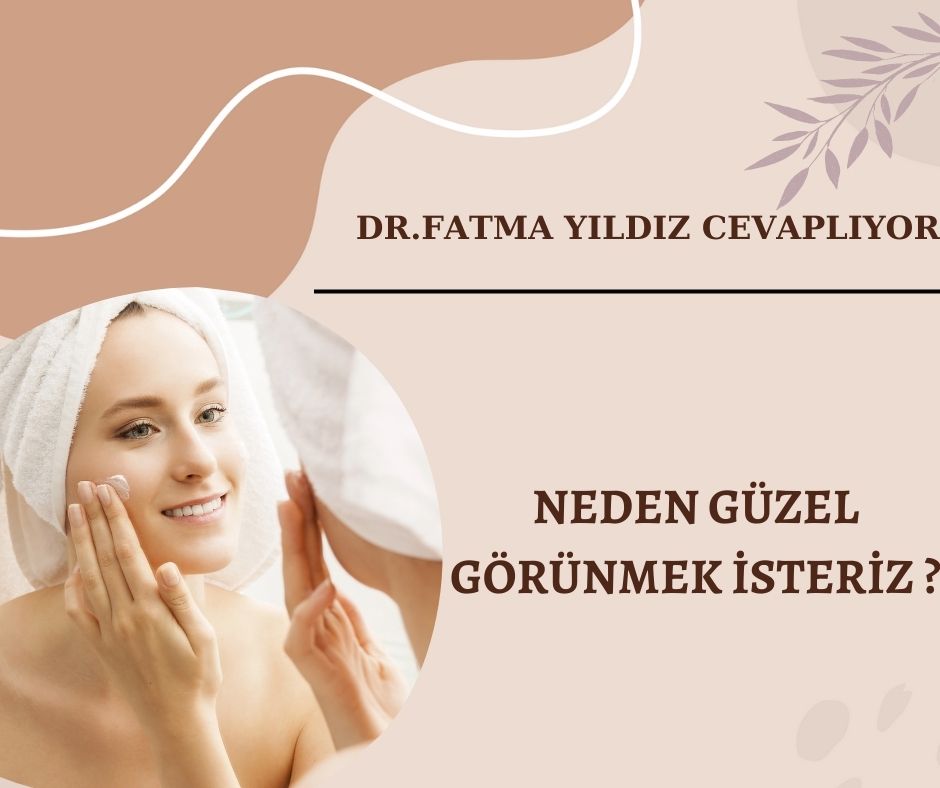

Why Do We Want To Look Beautiful?
French poet Paul Valéry said, “Health is the silence of all organs,” while the World Health Organization defines health as not just the absence of disease, but a state of complete physical, mental and social well-being. Beauty has been defined in different ways throughout history, and this concept is still unclear to many people.
Cosmetic surgeons have difficulty defining beauty, and they are not alone; different answers are received when asked from different people. For this reason, it is important to focus more on psychology and try to understand the feeling of beauty in people's minds in order to understand beauty. It is not enough to reduce beauty to only external appearance; this feeling is also affected by the person's inner world and past experiences.
What is Beauty?
Although it is not easy to define beauty, it can be explained with some general expressions:
• Beauty is a harmony of shapes and proportions that give us pleasure and inspire admiration. However, it varies according to cultures.
• The balance between shape and volume is a part of beauty.
• Beauty is an aesthetic feeling that is seen with the eye and inspires admiration.
Philosopher David Hume says that beauty is not a feature of something, but a perception in the mind of the person who looks at it. That is, something may be beautiful to one person but not to another. In other words, beauty is in the eye of the beholder.
Beauty and Attractiveness
Attractiveness and beauty are sometimes confused. Names such as Cleopatra and Marilyn Monroe were described as attractive, not beautiful. Attractiveness can last a long time, but beauty can fade over time. Therefore, a person's beauty is not only dependent on physical appearance; personality, soul, and the mental and emotional elements we call "heart" also affect the perception of beauty.
Lorenz's Theory of Beauty
Nobel Prize-winning scientist Konrad Lorenz says that beauty is an instinctive feeling. According to him, the more a face looks like a child, the more it is cute and protective. Large eyes, round cheeks, and soft features stimulate this feeling.
People with child-like features can be found more attractive. For this reason, makeup and cosmetic surgery often try to create a youthful appearance. Lipsticks, blushes, and smooth skin products mimic the natural freshness of a child's face.
Conclusion
Beauty is not just a superficial concept; People's past experiences, emotions and cultural perspectives affect their perception of beauty. Although this perception begins in the eyes of a person, it is shaped by their heart and mind. Therefore, beauty can be defined as a whole that gives pleasure. However, it should not be forgotten that beauty is like an iceberg; the visible part is only a very small part.
 Call
Call
 Whatsapp