


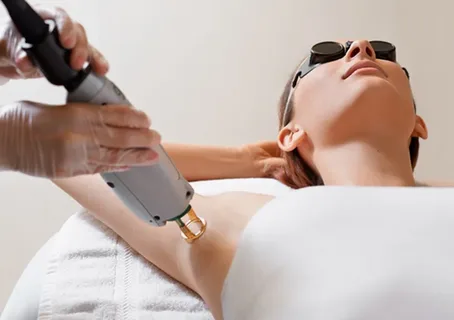

During laser hair removal, high-energy laser beams focus on the hair follicles and break down these pigments. This prevents hair growth and results in fewer hairs in the long run. Laser hair removal can be applied to almost any part of the body and is especially effective in sensitive areas such as the legs, underarms, bikini area and face.
Laser hair removal is performed by a specialist dermatologist or aesthetician. During the procedure, a special cooling system is used to protect your skin and minimize discomfort. Laser hair removal is less painful and results faster than traditional methods.
Effect of Laser Hair Removal
Laser hair removal prevents hair growth and provides permanent results. This process prevents hair regrowth by targeting the pigments in the hair follicles. Laser beams stop hair growth by breaking down the hair follicles.
Laser hair removal is customized according to the needs of your body. The most appropriate laser type is selected by taking into account factors such as hair structure, color and texture. In this way, the most effective results are obtained according to the personal characteristics of each individual.
Laser hair removal provides more permanent results compared to traditional methods. However, different results can be achieved depending on each individual's body structure and hair characteristics. While some people see faster and more noticeable results, others may require a longer process.
Does Hair Grow After Laser?
After laser epilation, some people may experience hair growth. This is a normal process and an expected result. Since laser epilation targets the pigments in the hair follicles, hair growth is prevented. However, not every hair follicle may be affected at the same time and some hairs may grow later.
During the laser epilation process, the pigments in the hair follicles are broken down and the hair may fall out. However, since not all hair follicles are affected at the same time, some hairs may grow back after the procedure. This usually happens within a few weeks and less hair growth is seen in subsequent sessions.
Laser epilation cannot completely prevent hair growth, but it significantly reduces hair density. The hairs that grow are thinner, sparser and weaker than before. Therefore, hairs that grow after laser epilation can usually be managed more easily and less disturbingly.
Laser Hair Removal Process
The laser hair removal process consists of several steps:
Preliminary Assessment: First, a comprehensive assessment is performed by a dermatologist or aesthetician. Factors such as your skin condition, hair structure, color and texture are examined. In this way, the most appropriate laser type and treatment protocol are determined.
Preparation: Before the procedure, your skin must be clean and dry. In addition, special precautions can be taken for sensitive areas. Some medications or skin products should not be used before the procedure.
Application: Laser hair removal is performed by a specialist healthcare professional. Your skin is cooled to minimize discomfort. Laser beams target the pigments in the hair follicles, preventing hair growth.
Aftercare: After the procedure, special care is applied to your skin. In this way, your skin is healed and irritation is prevented. In addition, special care products and recommendations are given to you.
Follow-up Sessions: Laser hair removal is usually performed in several sessions. It is recommended that there be a period of 4-8 weeks between each session. In this way, the pigments in the hair follicles are completely broken down and hair growth is prevented.
The laser hair removal process is customized to each person’s needs. A dermatologist or aesthetician will determine the most appropriate treatment protocol for you and guide you through the process.
 Call
Call
 Whatsapp